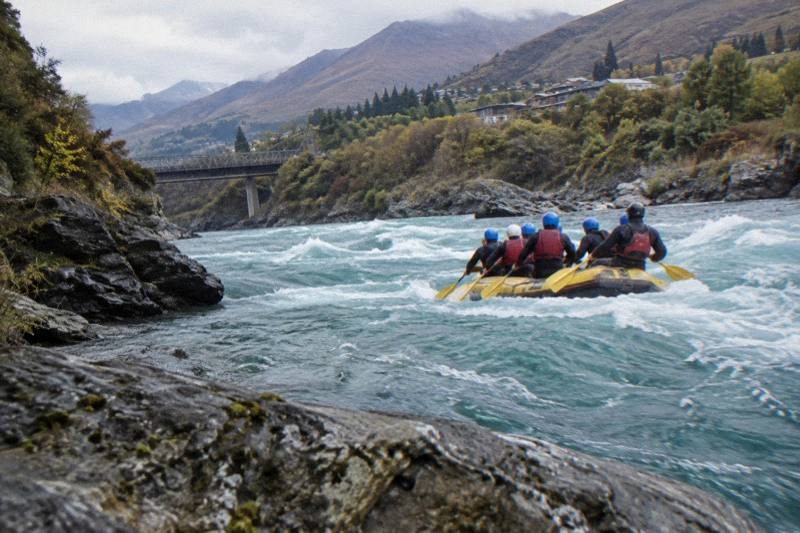
Kawarau River Facts: Flow, Gorge And Rapids
The Kawarau River drains Lake Wakatipu east from Queenstown through a gorge of schist cliffs and vineyards, carrying grade 2 to 3 white water, the longest commercially rafted rapid in New Zealand and a famous bungy bridge.
Short answer
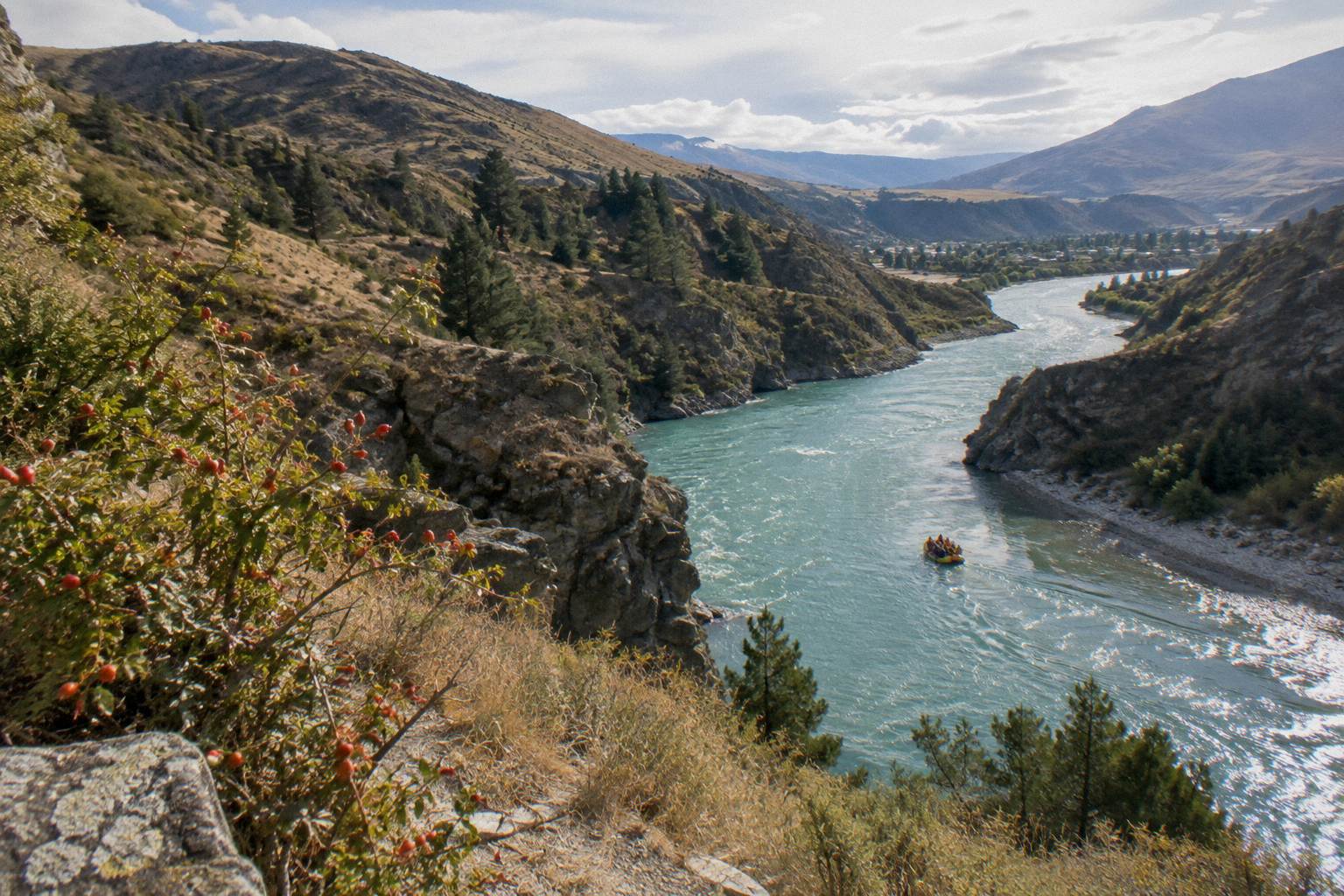
The Kawarau River is the only outlet of Lake Wakatipu, flowing east from Queenstown. Rafting trips run 8 km of the river, grade 2 to 3, ending in the Gibbston Valley. The Dog Leg, at 400 m, is described by the operator as the longest commercially rafted rapid in New Zealand. Trips run from NZ$249 per person.
Where Does The Kawarau River Start And Finish?
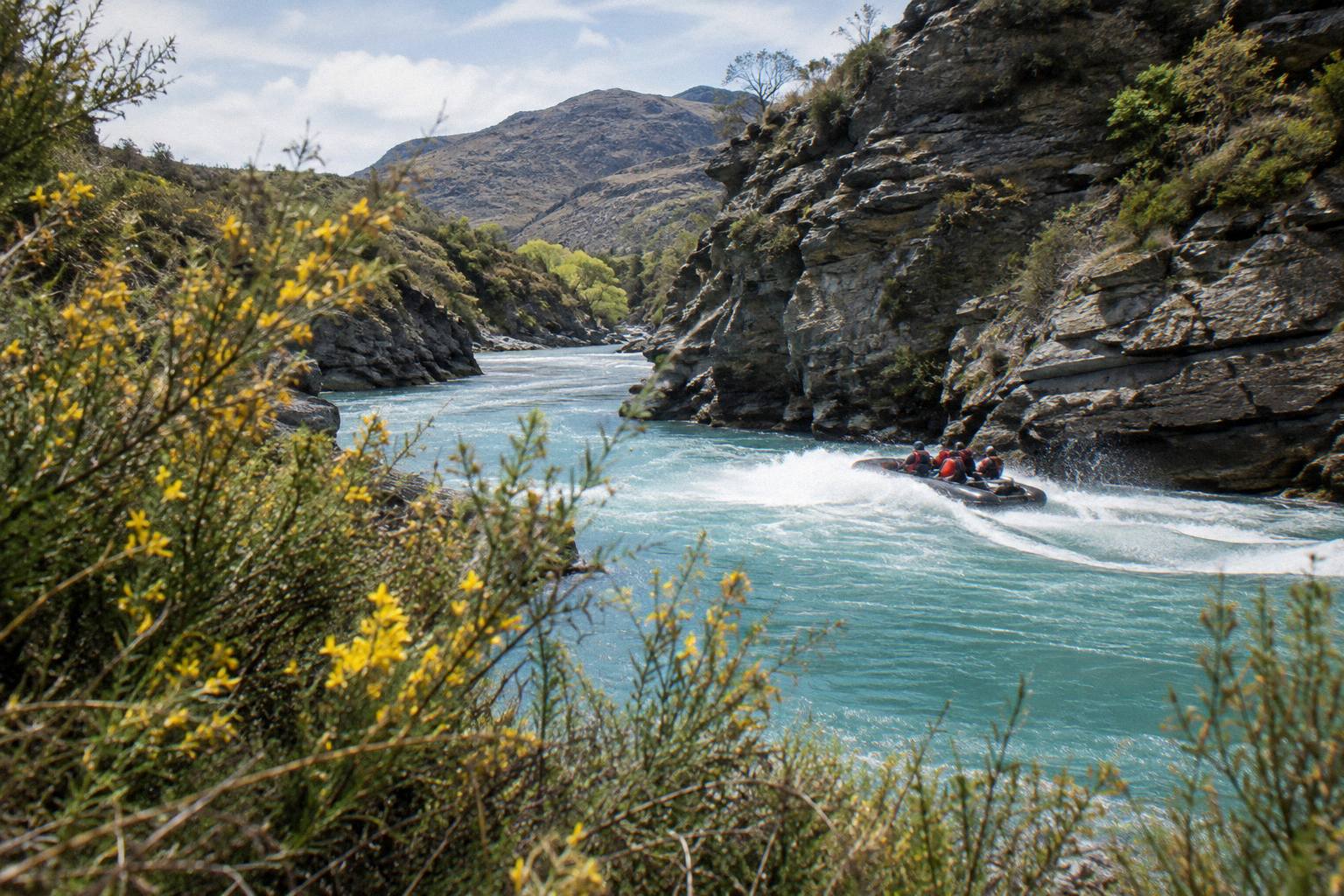
The Kawarau River starts at Lake Wakatipu, known in te reo Māori as Whakatipu-wai-Maori, where water leaves the lake near Frankton as the lake's only outlet, and it flows east from Queenstown through the Kawarau Gorge past the Remarkables, old gold workings, and Gibbston Valley vineyards on its way downstream.
For a town surrounded by rivers, the geography is unusually tidy. The Shotover joins the Kawarau not far below the lake outlet, bringing its own load of water out of Skippers Canyon. Further east the gorge opens toward Gibbston, where the river slows between the wineries and the rafting trips finish. An operator's own description of the river covers the rafting stretch and its grade, and it is the clearest single read on what the water actually does: the RealNZ Kawarau rafting page.
The name carries more than one story. Fans of The Lord of the Rings will know the river as the River Anduin, a name used in the trip descriptions themselves, because parts of the films were shot on this water. Gold mining history lines the gorge too, from stone remnants near the banks to the heritage of the 1860s rush that shaped the whole Wakatipu district. The bungy bridge at Kawarau adds a modern chapter, and it still draws crowds daily.
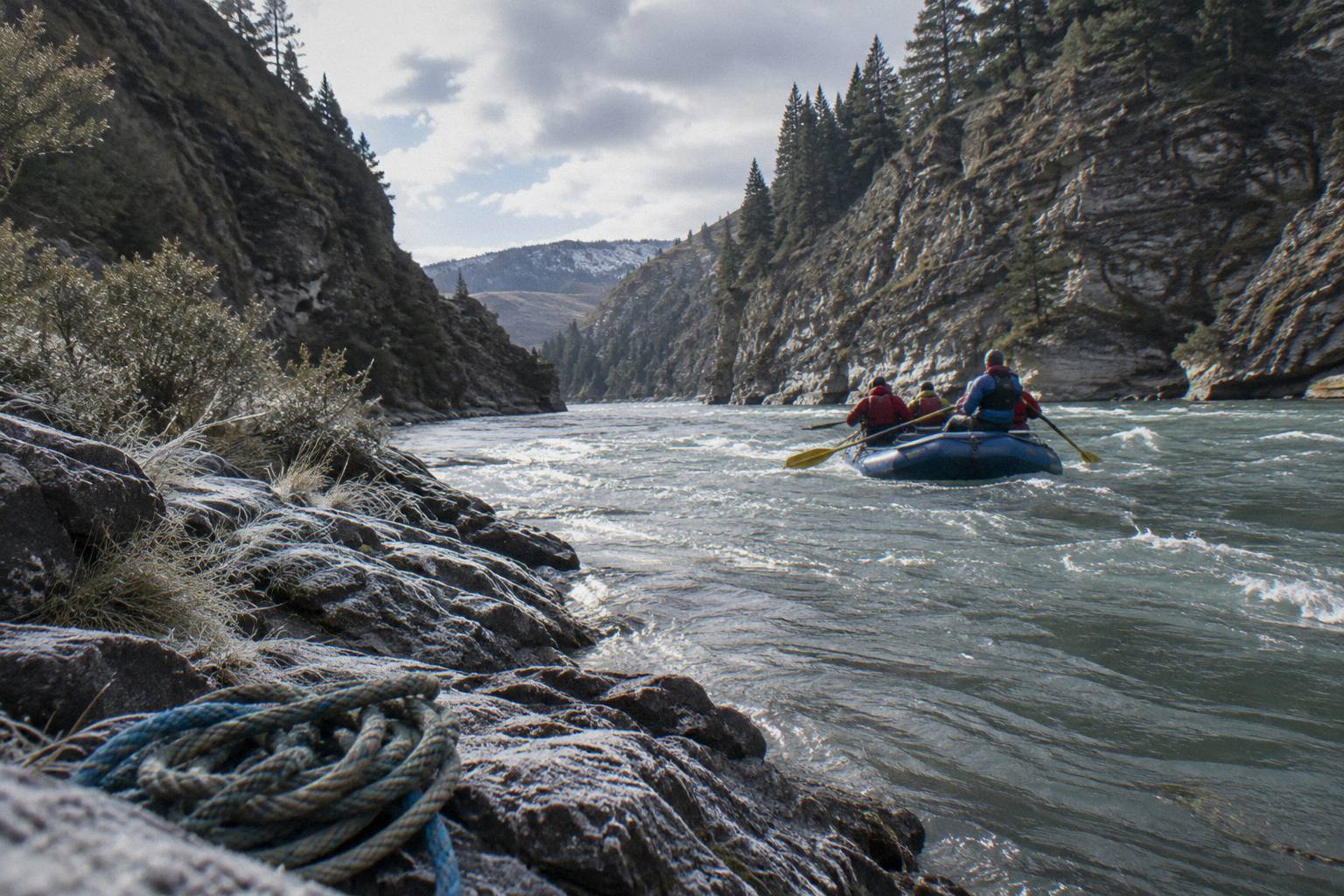
Readers comparing the two Queenstown rafting rivers can dig deeper with the full Kawarau rafting planning guide, or contrast it with the Shotover River facts and flow rundown.
Quick Facts About The Kawarau River
The Kawarau River is the only outlet of Lake Wakatipu, graded 2 to 3 on the rafted stretch with a possible step up at higher water. Trips cover 8 km and finish in the Gibbston Valley, taking roughly half a day door to door from town. Prices range from NZ$249 to NZ$329 per person depending on the product, and the run suits first-timers and less confident swimmers.
| Fact | Detail |
|---|---|
| Water source | The only outlet of Lake Wakatipu (Whakatipu-wai-Maori), flowing east from Queenstown |
| Rafted distance | 8 km, ending in the Gibbston Valley |
| Grade | Grade 2 to 3, can reach grade 4 at higher water levels |
| Signature rapid | The Dog Leg, 400 m, called the longest commercially rafted rapid in New Zealand |
| Film link | Featured as the River Anduin in The Lord of the Rings |
| Drive to the start | About 25 minutes from Queenstown via Arrowtown |
| Drive back | About 30 minutes through the Gibbston Valley wineries |
| Rafting time on the water | 1 hour per trip |
| Nearby landmark | Kawarau Bridge Bungy at Gibbston, described as New Zealand's first bungy site |
| Who it suits | First-timers and less confident swimmers; water confidence recommended |
One nuance worth flagging early: the grade is written as a range, not a fixed number, because the river moves with the seasons. At typical levels the run sits comfortably at grade 2 to 3, and the operator's own wording notes it can reach grade 4 when the water is higher. That flexibility is exactly why the Kawarau has a reputation as the friendlier of Queenstown's two rafting rivers, and why families and nervous paddlers are pointed here first. It stays a real river with real current, but the pool-drop character gives swimmers room to breathe.
No flow, discharge or river-level figure is published in a form that belongs in a planning article, and none is needed to make a good decision. What matters practically is that trips operate depending on weather, river level and water temperature, portages may occasionally be required, and minimum guest numbers apply. If the level matters to your dates, ask the operator.
What Grade Is The Kawarau River?
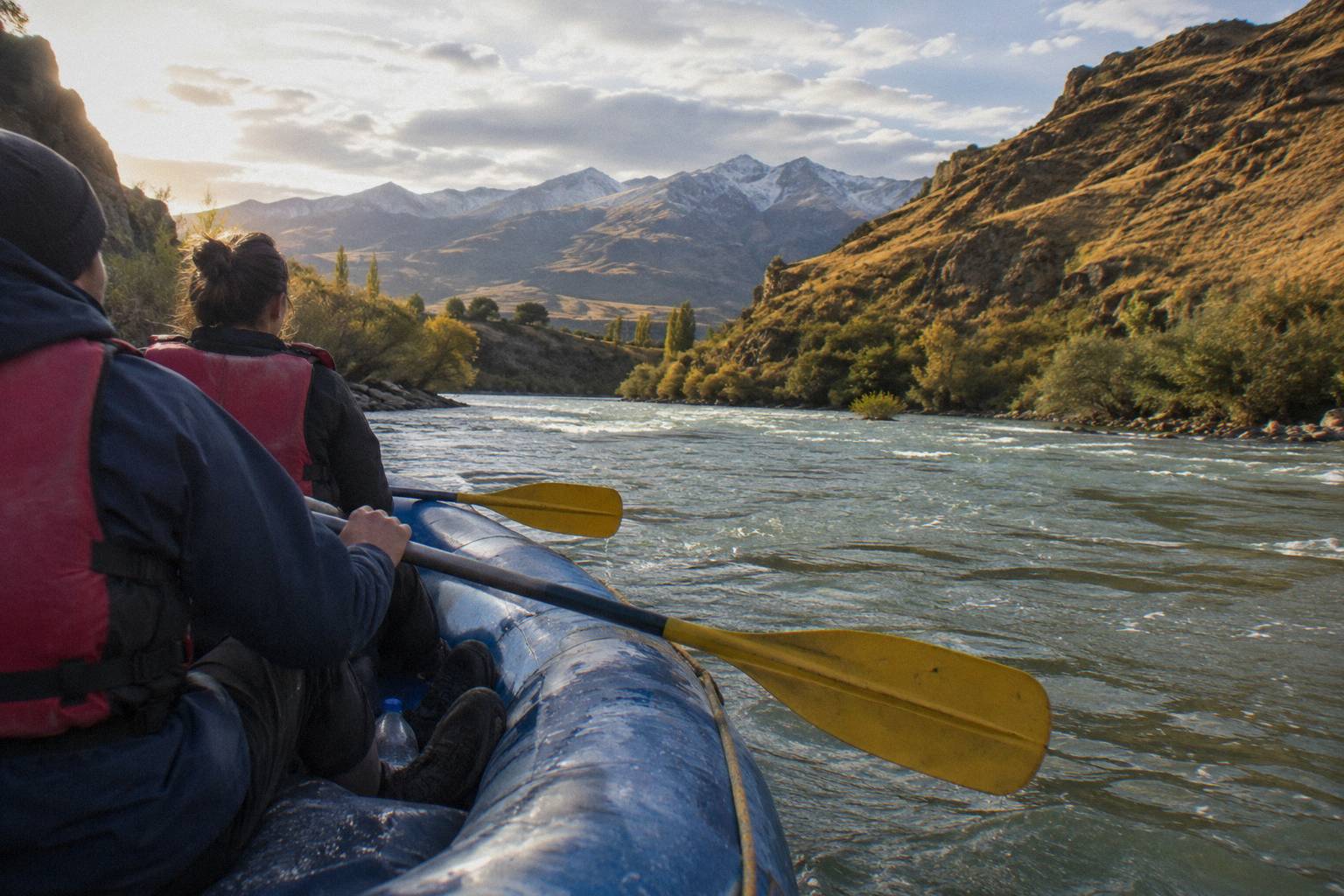
The international river difficulty scale runs from class 1, easy moving water, up to class 6, extreme rapids that are never commercially rafted. The Kawarau sits at grade 2 to 3 on its rafted stretch, which means straightforward rapids with clear channels and some waves that will soak everyone, rather than the steep, technical drops found on the Shotover. At higher water levels the river can reach grade 4, which brings bigger waves and more precise lines.
In plain words, grade 2 water has small waves and open passages where a swim would be calm rather than chaotic. Grade 3 adds moderate, irregular waves and the need to follow the guide's paddle calls, which is where the fun on the Kawarau lives. The operator describes the river as suited to first-timers and less confident swimmers, with water confidence still recommended, and that phrasing matches the water: you do not need to be an athlete, but you should be comfortable being splashed and, in the worst case, floating.
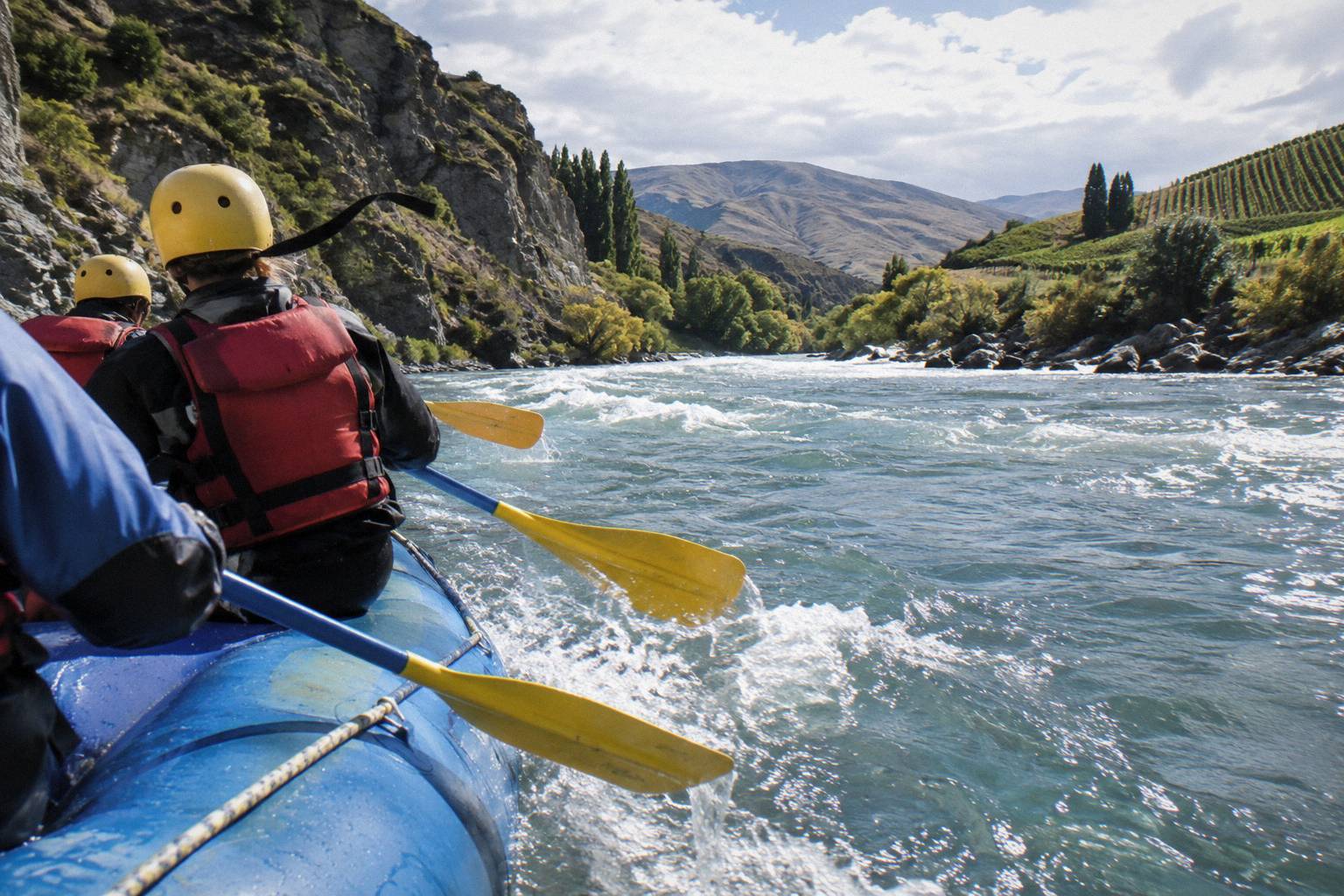
The step up to grade 4 at higher levels is worth understanding rather than fearing. Higher water generally means the waves grow and the margins narrow, and the operator adjusts the trip accordingly, including an optional cliff-jumping section and the chance to swim a rapid that both depend on weather and water level on the day. If you want a full grounding in the scale before choosing, the white water rafting grades explained guide breaks down every class in the same plain terms.
For context on the other side of town, the Shotover runs grade 3 to 5, and grade 5 is described by the operator as the highest grade commercially rafted in the world. The two rivers are genuinely different products: the Kawarau is the introduction, the Shotover is the escalation. Many visitors do one of each across a week, and the choice usually comes down to swimming confidence and appetite for consequence. The beginner's white water rafting primer walks through that decision in more depth.
The Dog Leg And Other Kawarau Rapids
The Dog Leg is the Kawarau's signature rapid: 400 m long, graded 3/4 in the operator's own description, and called the longest commercially rafted rapid in New Zealand. Most rapids last only seconds, but the Dog Leg keeps going, bending through the gorge in a sustained ride of waves and holes that fills a noticeable share of the whole 8 km trip.
Length changes the character of a rapid more than size does. A short grade 3 rapid is a burst of adrenaline and then a breather, while 400 continuous metres demand sustained paddling, teamwork and the ability to laugh while completely drenched. Guides brief the rapid before entering it, position the raft at the top, and call strokes through the bends. Guests who fall in on the Kawarau typically surface into moving but forgiving water, which is a large part of why the river suits less confident swimmers.
| Feature | What it is | Grade |
|---|---|---|
| The Dog Leg | 400 m rapid, the longest commercially rafted rapid in New Zealand | 3/4 in operator wording |
| Cliff jumping | Optional section, weather and water level dependent | Not graded |
| Swim a rapid | In-water chance to float through whitewater, conditions permitting | Not graded |
| General run | 8 km of the Kawarau ending in the Gibbston Valley | 2 to 3, up to 4 at higher levels |
Beyond The Dog Leg, the operator publishes no named rapid list for the Kawarau in the way the Shotover trips do, and the run is better understood as a sequence of short rapids joined by calm gorge floats. That rhythm is what makes the trip work for mixed groups: confident paddlers get the wave trains, nervous ones get recovery time between them, and everyone gets the scenery of the gorge walls sliding past.
The optional extras define the trip as much as the rapids. Cliff jumping is offered when conditions allow, usually from low rocks into deep water, and swimming a rapid gives a controlled taste of the river from inside it. Neither is compulsory, and both are skipped without ceremony when the water is up. Treat them as bonuses that make a good day better rather than guarantees, and the day will deliver.
What A Kawarau Rafting Trip Looks Like Hour By Hour
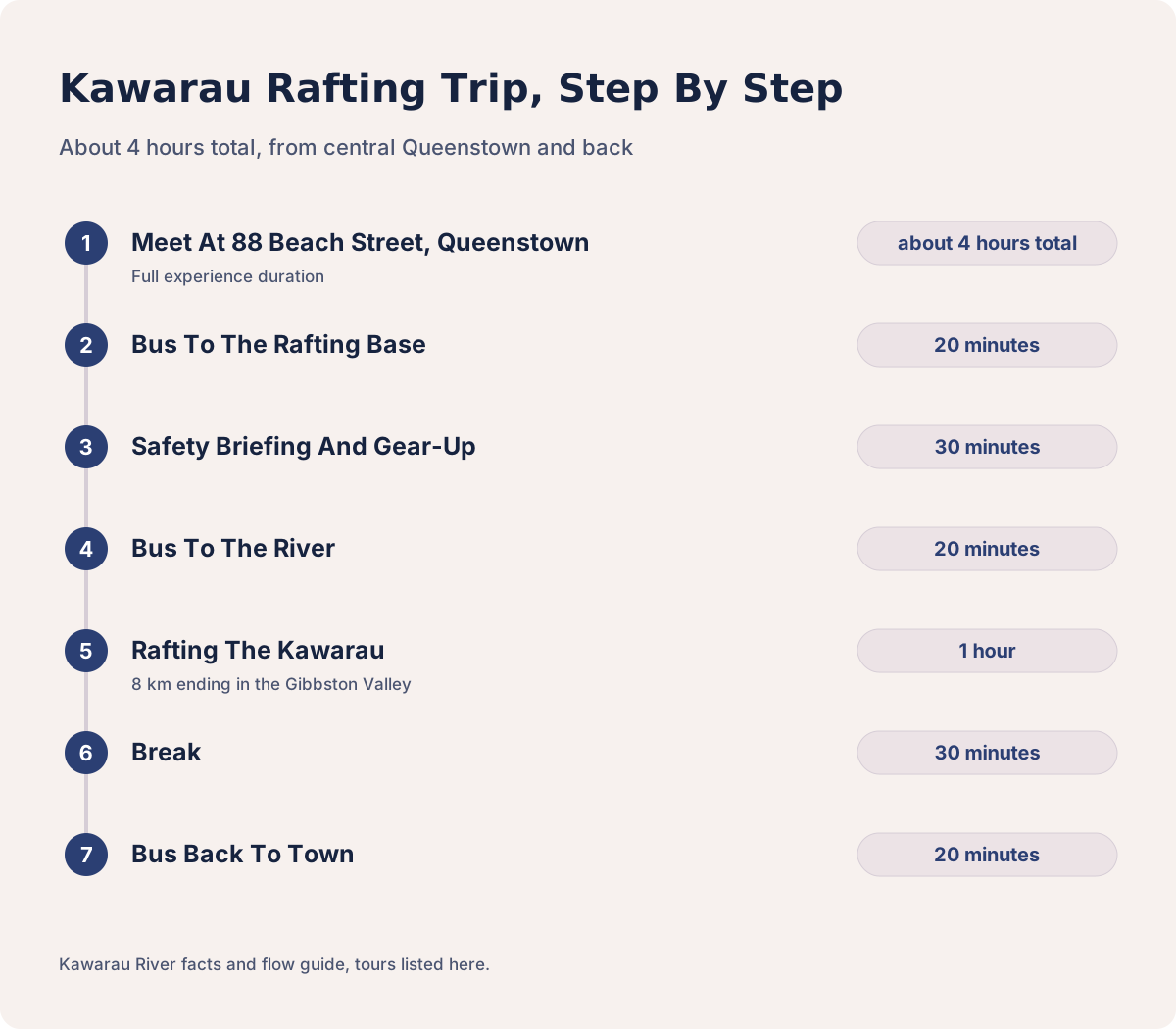
The full Kawarau Rafting experience lasts about 4 hours and follows a published rhythm: meet at 88 Beach Street in central Queenstown, bus 20 minutes to the rafting base, a 30 minute safety briefing and gear-up, another 20 minute bus to the river, then 1 hour of rafting, a 30 minute break, and 20 minutes back to town. On the water itself, 8 km pass between the put-in and the take-out in the Gibbston Valley.
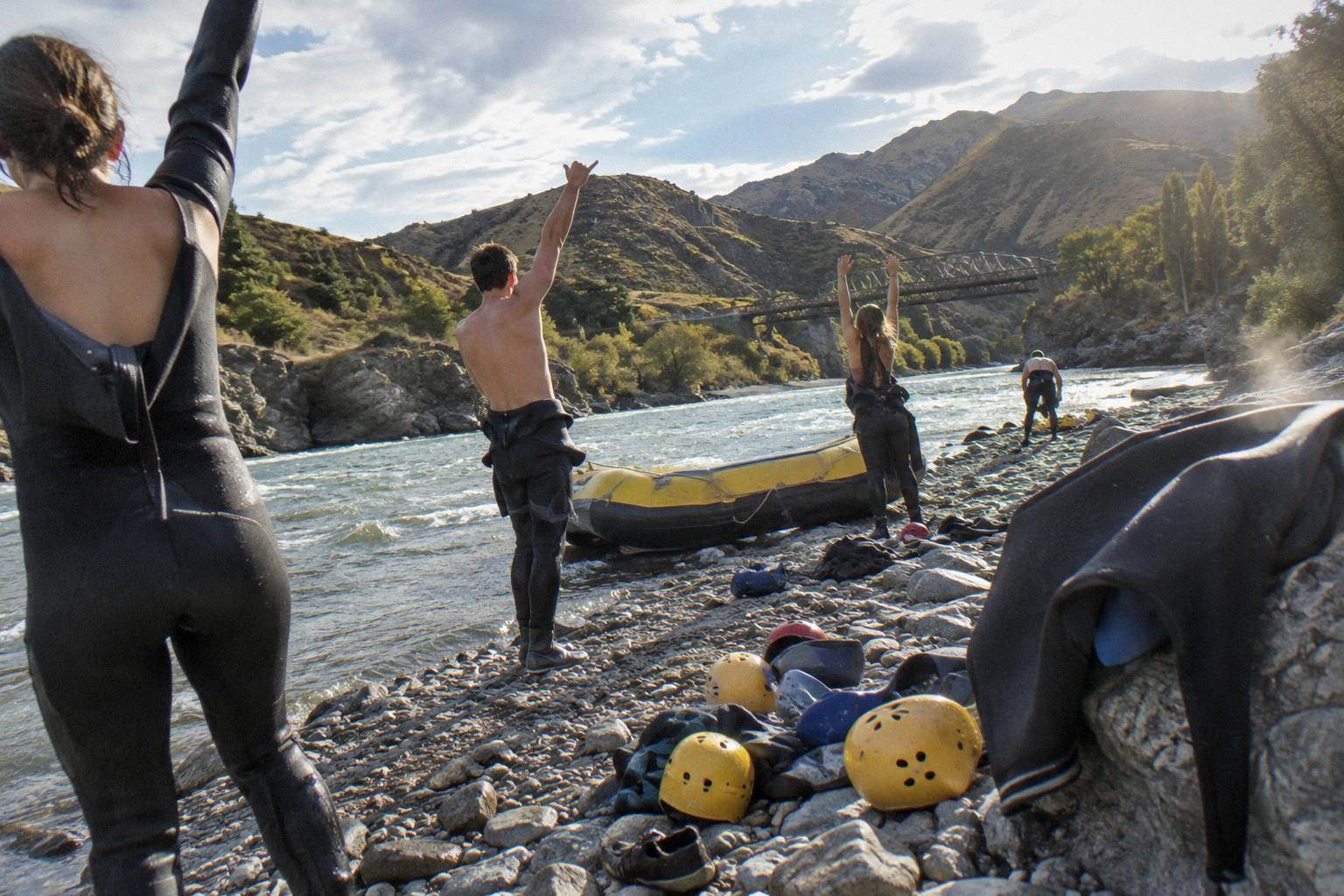
The structure matters because it explains the maths of the day. One hour of paddling sits inside four total hours, and the rest is logistics done well: a shuttle through Arrowtown toward the start, a drive home through the Gibbston Valley wineries that takes about 30 minutes, and time to change, shower and recover at the base. Hot showers are provided, along with the full kit of wetsuit, wetsuit jacket, spray jacket, paddle, helmet, booties and life jacket.
| Stage of the day | Duration |
|---|---|
| Meet at 88 Beach Street, Queenstown | Arrive at least 20 minutes before departure |
| Bus from town to the rafting base | 20 minutes |
| Safety briefing and equipment | 30 minutes |
| Bus from base to the river | 20 minutes |
| Rafting the Kawarau | 1 hour |
| Bus from take-out | 20 minutes |
| Break | 30 minutes |
| Bus back to 88 Beach Street | 20 minutes |
The jet boat combo version rearranges the middle of the day. The Rafting Plus Jet Boat Combo begins with a free shuttle from town to the base, then swaps one leg of the itinerary for a 25-minute jet boat transfer covering 22 km of the Kawarau at 95 km/h, complete with 360-degree spins, arriving at the rafting station before the hour of rafting begins. The two products share the same river and the same rafting stretch, so the choice between them is about the ride out, not the paddle. The rafting versus jet boat comparison covers the trade-offs.
Departure times themselves are chosen on the booking calendar rather than fixed, so the day's shape above holds regardless of which slot you take. Hotel pickup is excluded, which is why every itinerary begins with a walk or short drive to 88 Beach Street, and why staying central in Queenstown keeps the morning simple. Arriving early is not optional padding; the 20 minute buffer exists for check-in, waivers and wetsuit fitting.
For readers weighing the base fare against the add-ons, the plain rafting product, "Queenstown: Kawarau River Whitewater Rafting", from NZ$249 per person with a 4.8 rating from 151 reviews for the combo and 4.7 from 48 reviews for the rafting-only fare, is the cleanest way onto the water. Check availability alongside the Kawarau rafting trip overview.
The Kawarau As The River Anduin
Yes, the Kawarau River appears as the River Anduin in The Fellowship of the Ring, with filming sequences shot on this water, and the trip descriptions themselves make the connection. For many visitors, that film link is the hook: wide water, high brown cliffs and mountains that look invented. The scenery is not a bonus layered on top of the river, it is the reason the films came here.
Location scouting logic and rafting logic happen to agree. The gorge is dramatic from water level, wide enough for camera boats and raft fleets alike, and close enough to Queenstown for a production day trip. The Family Adventures Skippers Canyon trip even names the Ford of Bruinen among its sights, further up the Shotover system, showing how thoroughly the region's rivers were woven into the films. The Kawarau's stretch of that legacy is the most accessible, since the rafting run passes through the same corridor of gorge that filled the cinema screen.
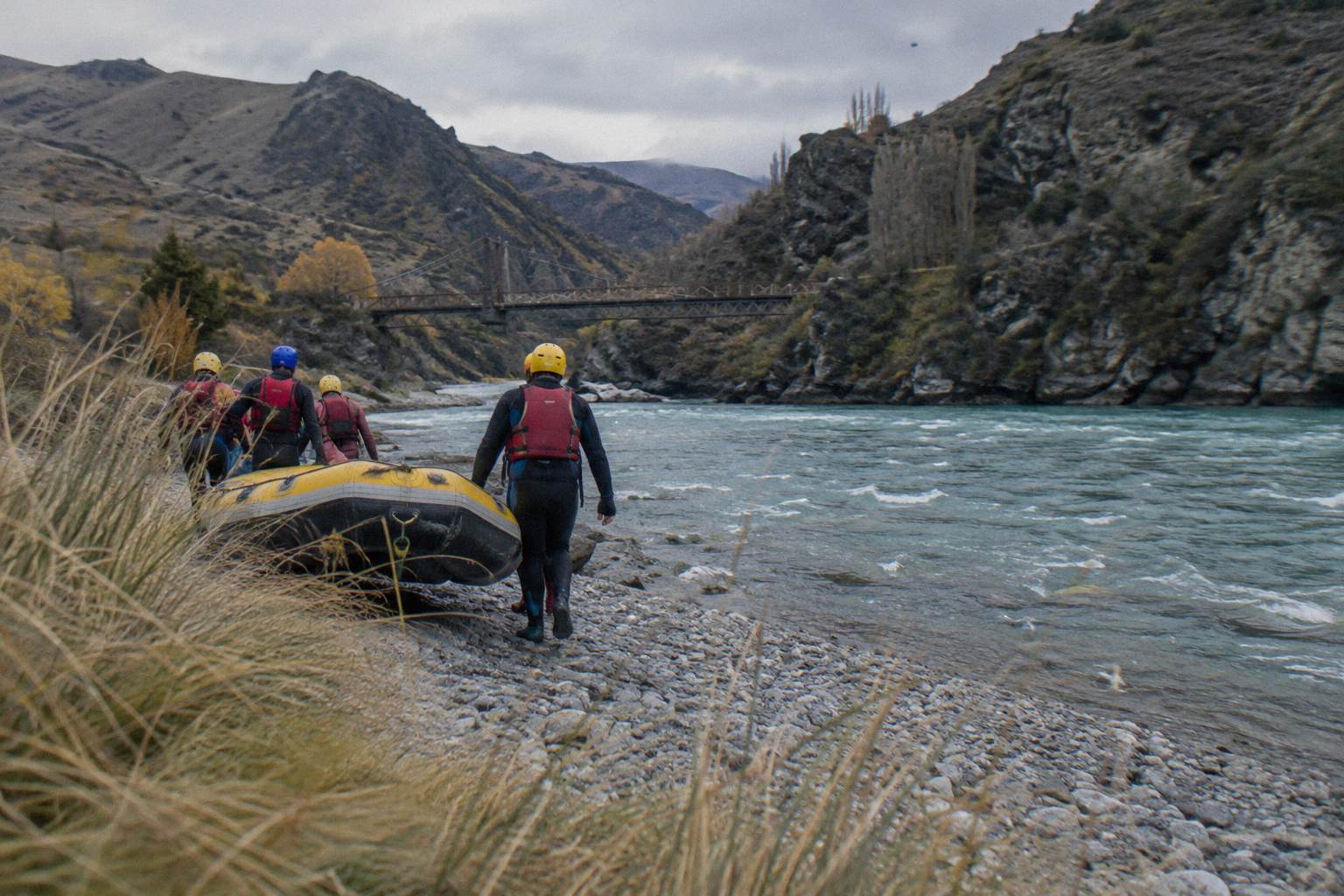
Film geography aside, the river's cultural footprint is wider than one franchise. The Kawarau Bridge at Gibbston carries the bungy operation that Challenge Rafting calls New Zealand's first iconic bungy jumping site, and the bridge still functions as a viewing spot for jumpers even if you never climb onto the platform yourself. Combine that with the Gibbston wineries on the drive home and the 1860s gold heritage scattered through the gorge, and the river reads as a compressed history of the region, from prospectors to pinot noir.
A practical note for photographers: the same rules apply on the Kawarau as on the Shotover, in that nothing, cameras and GoPros included, can be taken on the raft. Photos are handled by the operator, with Challenge Rafting including professional photos in its Shotover bookings, and the specifics for each product are on each booking page. If imagery matters to you, that is a detail worth confirming before you choose.
Kawarau Bridge Bungy And Combining The Gorge
The Kawarau Bridge Bungy sits on the river at Gibbston, in the same stretch the rafting trips finish near, and Challenge Rafting calls it New Zealand's first iconic bungy jumping site. The geography makes combinations natural: the rafting take-out, the bridge and the Gibbston wineries all sit within a short drive of each other, so a single morning on the river can stack into a full gorge day without backtracking.
The bridge deserves its own paragraph in any Kawarau article because it anchors the river's place in adventure tourism history. Bungy jumping arrived in New Zealand through this crossing, and the site still operates daily jumps over the exact water that rafts drift past below. Watching jumpers from the observation areas costs nothing and adds a spectator dimension rare in adventure sports, where usually only participants get the view.
Pairing activities works best when the sequencing is realistic. Rafting returns you to 88 Beach Street after about 4 hours, and the drive back through the Gibbston Valley takes roughly 30 minutes, so an afternoon at the bridge or a winery lunch slots in cleanly. Doing the bungy first and rafting after is also possible, though wet arms and a harness make an interesting combination. The rafting and bungy combo planning piece lays out the sensible orders.
One thing the river cannot yet offer in print: published operating months for the rafting products. The reviews span October through April across years, but a review's date range is not a schedule, and no operator months are published for these trips. Treat the calendar on the booking page as the authority, and if you are travelling in the shoulder season, confirm availability early rather than assuming.
How The Kawarau Compares With The Shotover
The two Queenstown rafting rivers split cleanly: the Kawarau runs grade 2 to 3 over 8 km and suits first-timers, while the Shotover runs grade 3 to 5 across 14 km with a tunnel, steeper drops and a stated higher risk of falling out. Price differences are small, with Kawarau rafting from NZ$249 and both lead Shotover trips from NZ$299, so the real decision is water confidence and appetite, not budget.
| Kawarau River | Shotover River | |
|---|---|---|
| Grade | 2 to 3, up to 4 at higher water | 3 to 5 |
| Distance rafted | 8 km | 14 km |
| Signature feature | The Dog Leg, 400 m | The 170 m Oxenbridge Tunnel |
| Who it suits | First-timers, less confident swimmers | Water-competent guests, moderate fitness |
| Swimming requirement | Water confidence recommended | Able to swim 25 m unaided |
| From price | NZ$249 per person | NZ$299 per person |
| Finish point | Gibbston Valley | Arthurs Point raft base |
The character difference is easiest to feel in the middle of each trip. On the Kawarau, the moments between rapids are calm floats through open gorge, with time to look up at the cliffs and hear the guide's stories. On the Shotover, the shuttle itself is part of the adventure, climbing the narrow dirt road that hugs the canyon's sheer cliffs toward the Deep Creek put-in, and the water that follows is faster, tighter and more relentless. The operator itself says the Shotover carries a higher risk of falling out than the Kawarau, which is the single most useful sentence in any comparison.
The Family Adventures product blurs the line slightly by running gentle grade 1 to 2 water on the Shotover, from NZ$329 per person, suitable from age 3, which shows the river's name matters less than the specific stretch and operator. Likewise, Challenge Rafting's Shotover trip, from NZ$299 with a 4.9 rating from 80 reviews, runs the same canyon as the RealNZ Shotover product while remaining its own trip. Buyers should compare the specific product, not just the river on the map.
If the answer to "which river" is still open after the table, the honest shortcut is swimming confidence. Comfortable in moving water and want the bigger day, choose the Shotover. New to white water, travelling with mixed confidence levels, or wanting scenery over adrenaline, choose the Kawarau. The head-to-head Shotover versus Kawarau guide works through the full decision tree.
Common Mistakes When Reading Kawarau River Facts
Most planning errors on the Kawarau come from assuming rather than checking: assuming the grade is fixed when it is a range, assuming hotel pickup is included when it is excluded, assuming cameras can come along when nothing can be taken on the raft, and assuming a published season exists when no operating months are printed. Every one of those assumptions breaks a real trip plan, and every one is avoidable with a two minute check before booking.
| Mistake | What actually happens |
|---|---|
| Expecting hotel pickup | Hotel pickup is excluded; all trips meet at 88 Beach Street, at least 20 minutes before departure |
| Bringing a camera on the raft | Nothing, cameras and GoPros included, can be taken on the raft |
| Treating grade 2 to 3 as guaranteed | The river can reach grade 4 at higher water levels |
| Assuming a fixed departure time | Start times are chosen on the booking calendar |
| Planning around published season dates | No operating months are published for these trips; check the calendar |
| Overlooking the age and weight limits | Minimum age 13, weight range 40 to 120 kg, verified at check-in |
The eligibility details catch more people than the rapids do. Minimum age is 13, weight must fall between 40 and 120 kg and is verified at check-in, under 18s need an accompanying adult or guardian consent with a guardian-signed waiver, and any heart condition other than blood pressure managed with medication excludes, as does pregnancy. Safety briefings are delivered in English and guests must understand them. None of that is fine print designed to trip anyone; it is the standard gate that keeps a commercial river trip commercial, and knowing it in advance saves a walk to 88 Beach Street that ends at the desk.
Underwear is a smaller but guaranteed rookie error: swimwear only under the wetsuit, no cotton, and glasses need a sports strap or stay behind. The full kit is provided, so the packing question is narrow, and the what to wear white water rafting guide covers it in detail.
Regulation is worth one sentence of anyone's research time. Adventure activity operators in New Zealand must be registered and have passed a safety audit, an offence otherwise, and WorkSafe New Zealand's public register is searchable by name, activity and location. The register is the authoritative check, not a blog's reassurance.
Planning Your Day On The Kawarau
A good Kawarau day starts with an early check-in at 88 Beach Street in central Queenstown, dressed in swimwear under your clothes with a towel and dry clothes waiting at the end. It finishes in the Gibbston Valley roughly 4 hours later with hot showers, a bus ride past the wineries and, often, a stop at the bungy bridge on the way.
Choosing between the two main products comes down to one question: do you want the 25-minute, 22 km jet boat run at 95 km/h with 360-degree spins on the way to the rafting station? Both include the same hour of rafting, the same equipment and the same river. The combo carries a 4.8 rating from 151 reviews against 4.7 from 48 for the rafting-only fare, and the NZ$80 difference buys the jet leg. Visitors short on days often treat the combo as two adventures for the price of one morning, and that arithmetic is fair.
Timing within the day matters less than timing within the year. Departure slots are picked on the calendar, morning or afternoon, and the morning or afternoon rafting comparison helps if your schedule is flexible. What you cannot do is plan around a published season for these trips, because none is printed; the calendar itself is the answer, and shoulder-season travellers should book and confirm rather than assume.
Finally, the paperwork that makes the day smooth: bring proof of age for anyone near the 13 year minimum, expect weights to be verified at check-in, arrive at least 20 minutes early, and leave everything you would hate to lose in the valuables locker at the base. Guests on the Skippers Canyon family trip get snacks included; on the Kawarau products, plan lunch in Gibbston or back in town after the showers. The river supplies everything else, including the stories.
The rafted Kawarau, its grade range, its 400 metre signature rapid and its film-scenery gorge are the whole reason Queenstown White Water Rafting exists as a destination rather than a footnote, and the trip choices above are the working summary of everything the water offers.
Common Questions About The Kawarau River
What Grade Is The Kawarau River?
The rafted stretch of the Kawarau runs grade 2 to 3, and the operator notes it can reach grade 4 at higher water levels. The Dog Leg rapid is described as grade 3/4. That places it well below the Shotover's grade 3 to 5 and makes it the standard choice for first-timers.
How Long Is The Kawarau Rafting Trip?
The rafting-only product lasts about 4 hours in total, of which 1 hour is on the water covering 8 km of river. The jet boat combo lasts about 4.5 hours because it adds a 25-minute jet boat transfer before the rafting.
Is The Kawarau Or The Shotover Better For Beginners?
The Kawarau. It runs grade 2 to 3 against the Shotover's grade 3 to 5, the operator recommends it for first-timers and less confident swimmers, and the operator states the Shotover carries a higher risk of falling out.
Where Does Kawarau River Rafting Start From?
All the RealNZ Kawarau trips meet at the RealNZ Visitor Centre, 88 Beach Street, Queenstown, at least 20 minutes before departure. Hotel pickup is excluded. From there a bus covers the roughly 25 minute drive toward the start via Arrowtown.
Can You Cliff Jump On The Kawarau?
Yes, conditionally. An optional cliff-jumping section is offered depending on weather and water level, along with the chance to swim a rapid. Neither is guaranteed on any given day, and both are skipped when conditions do not allow them.
Is The Kawarau River The River Anduin?
On screen, yes. The Kawarau appears as the River Anduin in The Lord of the Rings, a connection the trip descriptions themselves make, and the surrounding gorge scenery is why the production filmed here.