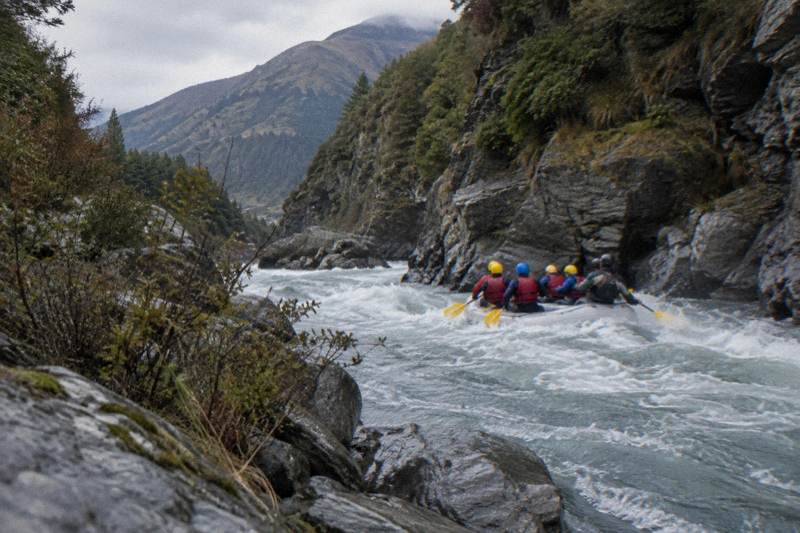
Is White Water Rafting Safe? Risks, Guides And Gear
Safety is the number one worry for first-time rafters, and the honest answer comes from how Queenstown trips are actually run: operators must be registered and audited, every trip issues a full kit of protective gear, health and swimming screens keep unsuitable guests off the water, and conditions on the day decide whether a trip goes at all.
Short answer
Commercial rafting in Queenstown is run under New Zealand adventure activity rules: operators must be registered with WorkSafe and have passed a safety audit. Every trip includes a safety briefing, helmet and life jacket, guests are screened for age, weight, heart conditions, pregnancy and swimming ability, and trips only run when weather, river level and water temperature allow.
Safety is the single biggest question first-time rafters ask, and it deserves a straight answer rather than a slogan. Queenstown rafting runs inside a regulated system: adventure activity operators in New Zealand must be registered with WorkSafe and must have passed a safety audit before they may legally take paying guests down a river. On top of that legal framework, each trip layers its own protections, from mandatory briefings and full protective kit to health screens and weather calls made on the day. None of that makes rafting risk-free, and no operator claims it does. What it means is that risk is managed deliberately, at several separate layers, by people whose job is to manage it. Working through those layers one by one is the best way to decide whether a rafting trip fits you.
How Safe Is White Water Rafting In Queenstown?
Queenstown rafting safety rests on four separate layers that stack on top of each other: a national register that only admits audited operators, a safety briefing and full protective kit on every trip, health and ability screens that keep unsuitable guests off the water, and go or no-go calls made on the day against weather, river level and water temperature. Remove any one layer and the others still work; together they are what a commercial rafting trip actually is.
The first layer is legal. WorkSafe New Zealand keeps a public register of adventure activity operators, and it is an offence to provide an adventure activity unless the operator is registered, or excluded or exempted under the regulations. The second layer is the trip itself: nobody gets on a raft without a briefing, a helmet and a life jacket, and the two steeper Queenstown rivers add their own extras, such as a safety kayaker travelling with each Shotover raft. The third layer is you: age, weight, heart conditions, pregnancy and swimming ability are all screened before check-in, and weight is verified there. The fourth layer is the environment: trips run depending on weather, river level and water temperature, and portages may be required, which means sections can be walked around rather than rafted when conditions demand it.
For a quick orientation, the essentials look like this.
| Safety layer | What it covers on Queenstown trips |
|---|---|
| National regulation | Operators must be registered with WorkSafe and have passed a safety audit to legally run adventure activities |
| Pre-trip briefing | Safety briefing on every trip, roughly 30 minutes on the Kawarau itinerary |
| Protective gear | Wetsuit, wetsuit jacket, spray jacket, helmet, booties, life jacket, paddle |
| On-water support | Rafts carry at most eight people including the guide; a safety kayaker travels on each RealNZ Shotover trip |
| Guest screening | Minimum age 13 on the graded rivers, weight 40 to 120 kg verified at check-in, heart, pregnancy and swimming screens |
| Conditions call | Trips run depending on weather, river level and water temperature; portages may be required |
One point worth fixing early: the international river difficulty scale runs from class 1, easy, to class 6, extreme, and class 6 is not commercially rafted. Everything sold commercially sits inside that ceiling by definition. The Queenstown rivers run from grade 1 and 2 on the family trip up to grade 3 to 5 on the Shotover, and the operator's own words frame the top end: grade 5 is the highest grade commercially rafted in the world. If you want the grade system unpacked in full, the white water rafting grades explained guide walks through each class in plain language.
Who Regulates Rafting Safety In New Zealand?
New Zealand does not leave adventure safety to goodwill. WorkSafe New Zealand operates a public register of adventure activity operators, described as operators who have passed a safety audit and are authorised to provide adventure activities, and it is an offence to provide an adventure activity unless the operator is registered, or excluded or exempted by WorkSafe. Anyone can search the register by name, activity and location.
That single paragraph does most of the work when people ask whether rafting here is properly overseen. The register is public, searchable, and records each operator's status as Current, Cancelled or Suspended. The legal duty sits with the operator, not the customer: you are not expected to audit anyone. You can find the register and search it yourself at the WorkSafe adventure activities public register, and it is a reasonable five minutes of homework before booking any adventure activity in the country, rafting included.
What the register does not do is rank rivers or promise outcomes. Being registered means an operator has passed a safety audit and is authorised to run the activity; it does not mean the activity is free of risk, and no honest framing of commercial rafting would claim otherwise. Rivers move, weather changes, and guests arrive with different swimming ability and fitness. That is exactly why the audit sits at the top of the stack and the layers below it, briefing, gear, screening and daily conditions calls, carry the day-to-day work.
It also helps to know what rafting shares the framework with. Jet boating, bungy and other paid adventure activities in New Zealand fall under the same registration requirement, so the safety system you are relying on when you raft the Shotover is the same one governing the other headline Queenstown activities. If you are weighing rafting against a jet boat ride, the rafting versus jet boat comparison breaks down how the two experiences differ on the water, including the fact that jet boat and rafting trips on the Shotover never share a stretch of river except one 500 m stretch after the Oxenbridge Tunnel.
If you are ready to look at specific trips, these three span the full safety spectrum in Queenstown, from a grade 1 and 2 family float to grade 3 to 5 white water.
What Safety Gear Is Provided On Every Trip?
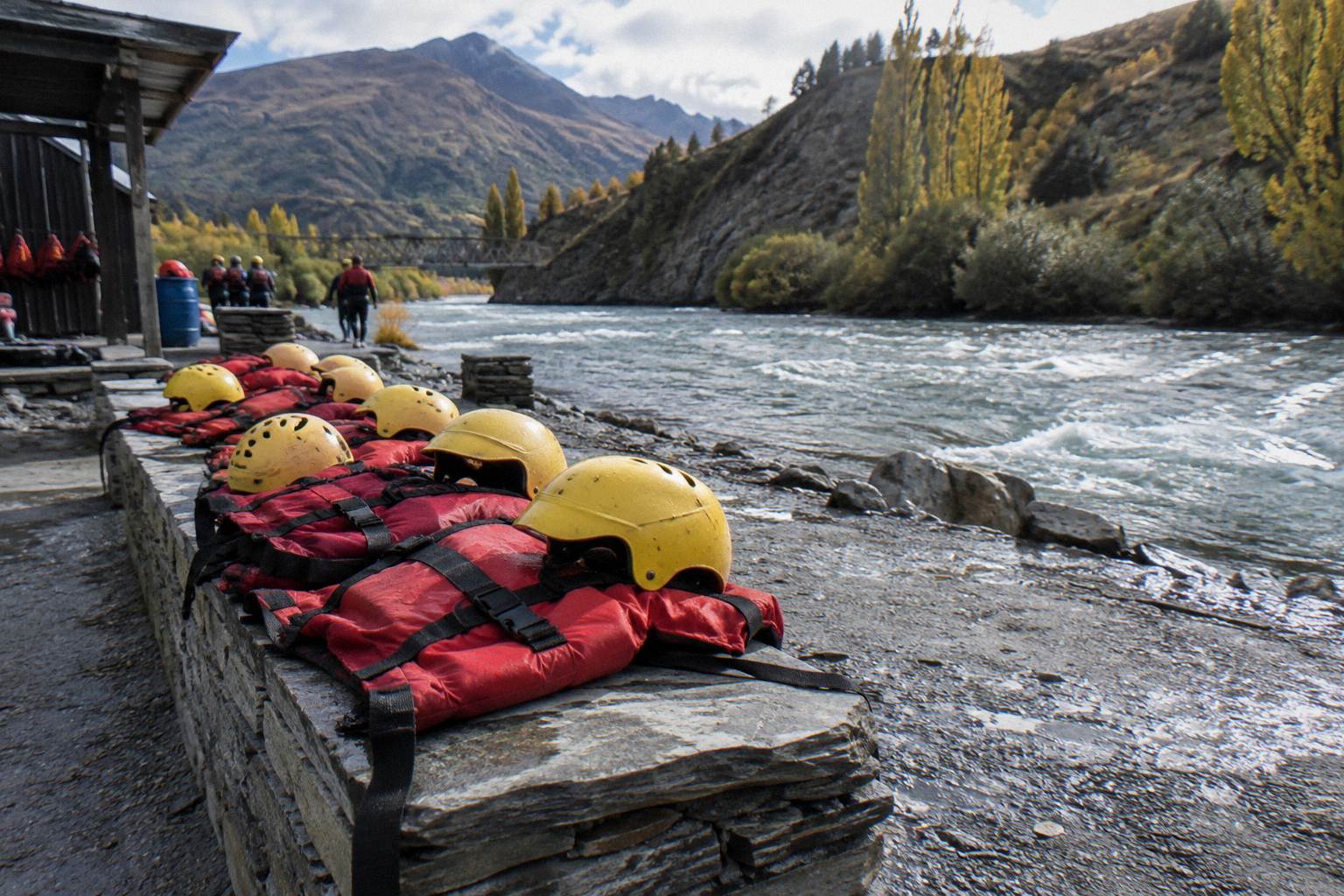
Every commercial rafting trip in Queenstown issues the same core kit before anyone touches the water: a full wetsuit, a wetsuit jacket, a spray jacket, a helmet, wetsuit booties, a life jacket and a paddle. Nothing on that list is optional or rented extra; it is the baseline equipment of the activity, handed out and fitted at the rafting base, with hot showers waiting at the end.
The gear list matters because it is the layer that protects you continuously, not just at a moment of crisis. A life jacket keeps you buoyant if you end up in the water, which is a real possibility on any graded river, and the operator is direct about the difference between the two main rivers: the Shotover carries a higher risk of falling out than the Kawarau. The helmet does the same job for your head against rock contact. The wetsuit stack, suit plus jacket plus spray jacket, is what lets people raft mountain river water in comfort across a whole session rather than minutes. Extra-large and child-size wetsuits are available, so the fit is not one-size-fits-all.
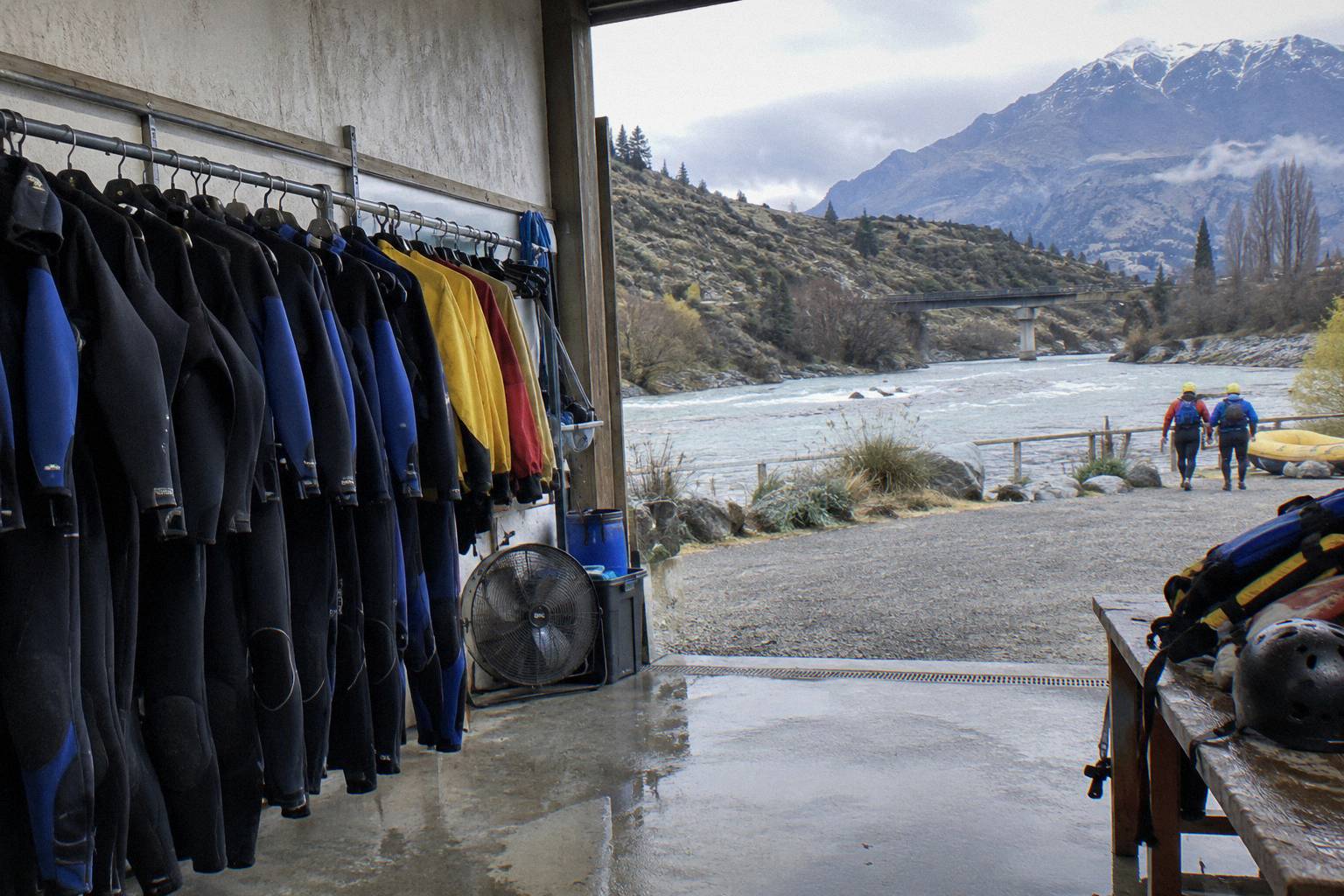
There are two rules around the kit that catch people out. First, you wear swimwear only under the wetsuit, and no cotton, because cotton soaks and stays soaked. Glasses need a sports strap or stay behind. Second, nothing can be taken on the raft on the RealNZ Shotover trip, no camera and no GoPro, which is a deliberate safety rule rather than an inconvenience; professional photos are included in the booking on the Challenge Rafting Shotover trip, so the memory does not depend on your own device. The what to wear rafting guide covers the clothing side in more detail, and the cameras and valuables on rafting trips guide handles the electronics question, including the valuables locker at the Shotover raft base.
| Trip | Equipment issued | Extras on the day |
|---|---|---|
| Shotover Rafting, Half Day | Wetsuit, wetsuit jacket, spray jacket, paddle, helmet, booties, life jacket | Hot showers and valuables locker at the base; safety kayaker on each trip |
| Challenge Rafting, 4 Hours | Full wetsuit, booties, life jacket, helmet, equipment | Safety briefing; professional photos included; hot showers at Rafters Lodge |
| Kawarau Rafting Only, Base Fare | Wetsuit, wetsuit jacket, spray jacket, paddle, helmet, booties, life jacket | Hot showers; optional cliff jumping if weather and water level allow |
| Rafting Plus Jet Boat Combo | Wetsuit, wetsuit jacket, spray jacket, paddle, helmet, booties, life jacket | 25-minute jet boat transfer to the rafting station before the rafting |
| Rafting And Skippers Canyon Combo | Rafting equipment for a grade 1 and 2 trip | Snacks included; 1.5 hours of rafting in Skippers Canyon |
The combo trips deserve a note, because adding a jet boat to a rafting day does not change the safety stack, it extends it. The Rafting Plus Jet Boat Combo uses a 25-minute jet boat transfer covering 22 km of the Kawarau at 95 km/h with 360-degree spins to reach the rafting station, then runs the same rafting session with the same gear and briefing. It is a bigger day, not a riskier format.
Who Gets Screened Out Before The Trip?
The screens are specific and enforced at check-in: minimum age 13 on the graded rivers, minimum weight 40 kg and maximum 120 kg verified in person, any heart condition except blood pressure managed with medication, pregnancy, and the inability to swim 25 m unaided all exclude. Guests must also understand the safety briefing in English and sign a waiver, with guardian consent and signatures required for anyone under 18.
Reading that list as a set of exclusions gets it backwards. Every screen removes a known mismatch between a guest and a river, before that mismatch can happen in moving water. Weight limits exist because life jackets and rafts are engineered and tested within a range. The swimming screen exists because a graded river is not a pool. The heart condition screen exists because paddling is physical work. There is no maximum age; what is asked instead is a good level of physical fitness, and disabilities are assessed case by case rather than blanket-banned, with extra-large and child-size wetsuits available for fit. The family trip in Skippers Canyon sits outside most of the screens: it is suitable for everyone from 3 years upwards, water confidence is not necessary, and the rapids are grade 1 and 2.
| Screen | RealNZ graded trips | Challenge Rafting Shotover | Family trip, Skippers Canyon |
|---|---|---|---|
| Minimum age | 13, proof of age may be required | 13 | 3 years upwards |
| Weight | 40 kg to 120 kg, verified at check-in | 40 kg to 120 kg | No limit published |
| Swimming | Water-competent, able to swim 25 m unaided | Water competence required; non-swimmers not suitable | Water confidence not necessary |
| Heart conditions | Any heart condition except managed blood pressure excludes | Heart condition or heart medication excludes | Gentle grade 1 and 2 trip |
| Pregnancy | Excluded | Not allowed on grade 3 or above | Grade 1 and 2 only |
| Minors | Under 16 with a guardian; under 18 guardian consent and signed waiver | Under 17 accompanied by a guardian; under 18 guardian-signed waiver | Family trip from age 3 |
| Briefing | Must understand safety briefings in English | Safety briefing included | Gentle trip |
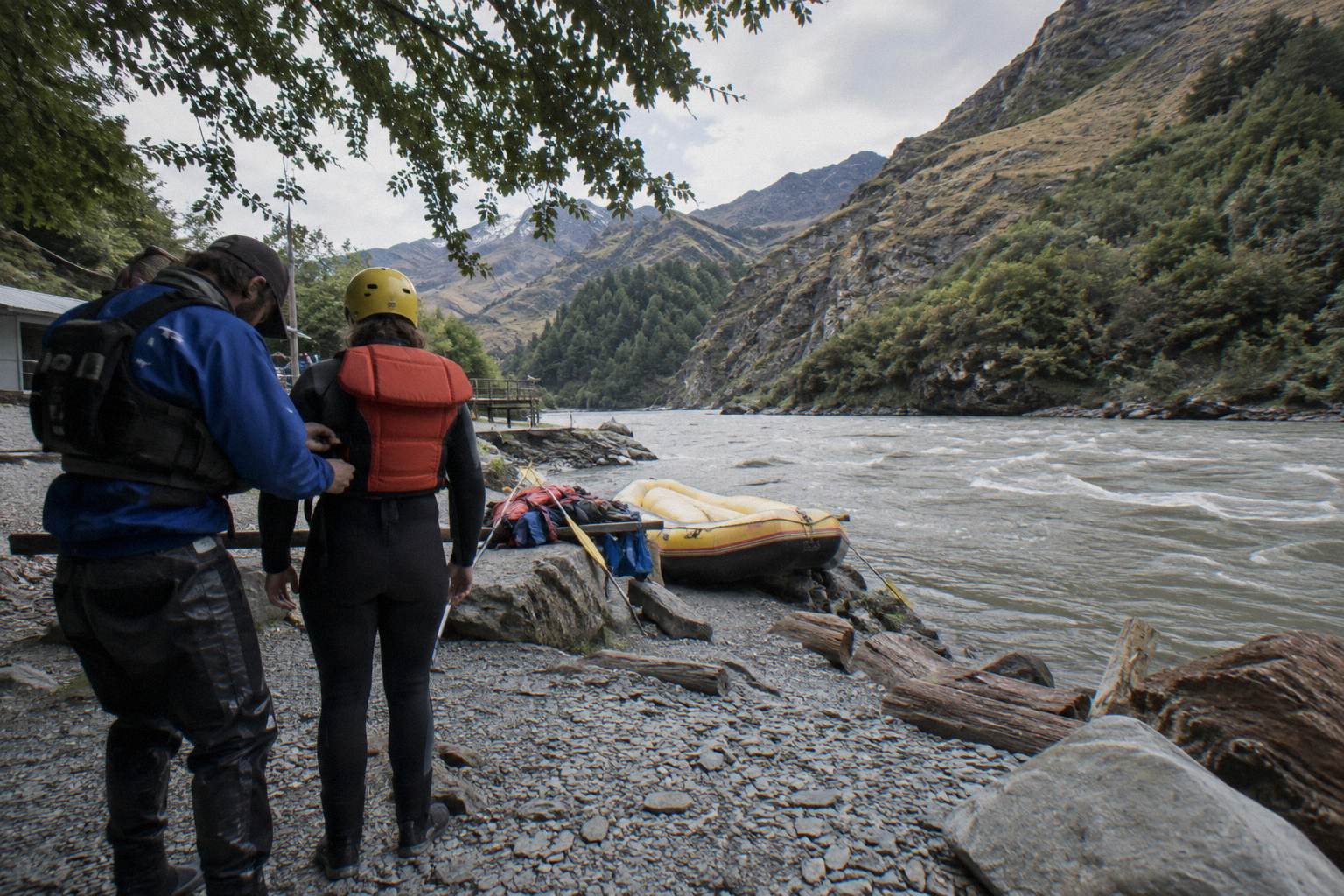
If you already know you fall outside a screen, say so when booking rather than at the river. The operators are blunt about the boundaries because the boundaries are what let everyone else paddle hard into the next rapid. If swimming ability is your specific worry, read rafting if you cannot swim, and if it is falling out of the raft that keeps you up at night, what happens if you fall out of a raft walks through the drilled response without inventing technique the sources do not cover.
The Shotover half day with RealNZ, from NZ$299 per person, is the trip where the screens matter most: grade 3 to 5 water, six rapids, the 170 m Oxenbridge Tunnel, and the operator's own statement that the Shotover carries a higher risk of falling out than the Kawarau.
Which River Is Riskier, The Shotover Or The Kawarau?
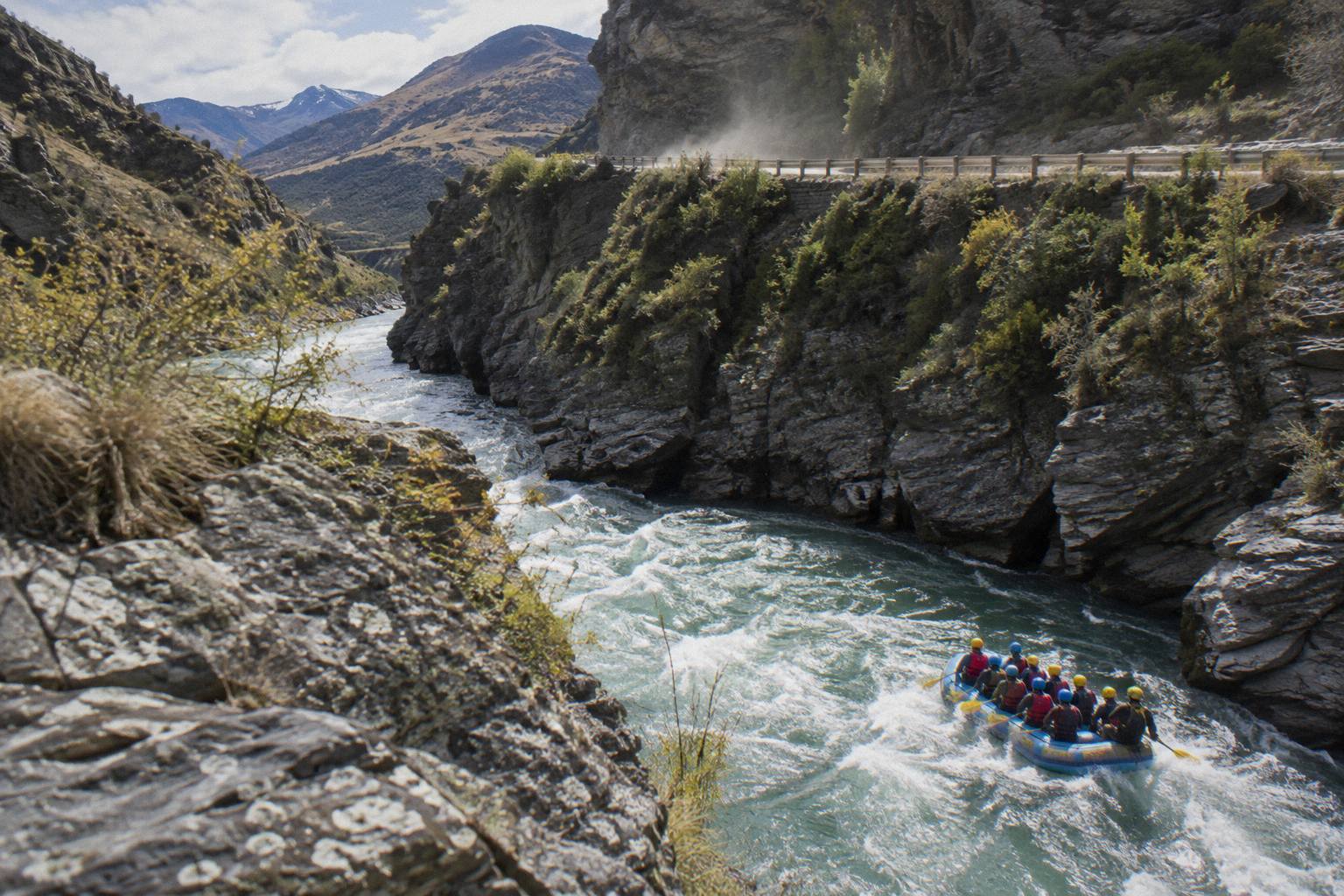
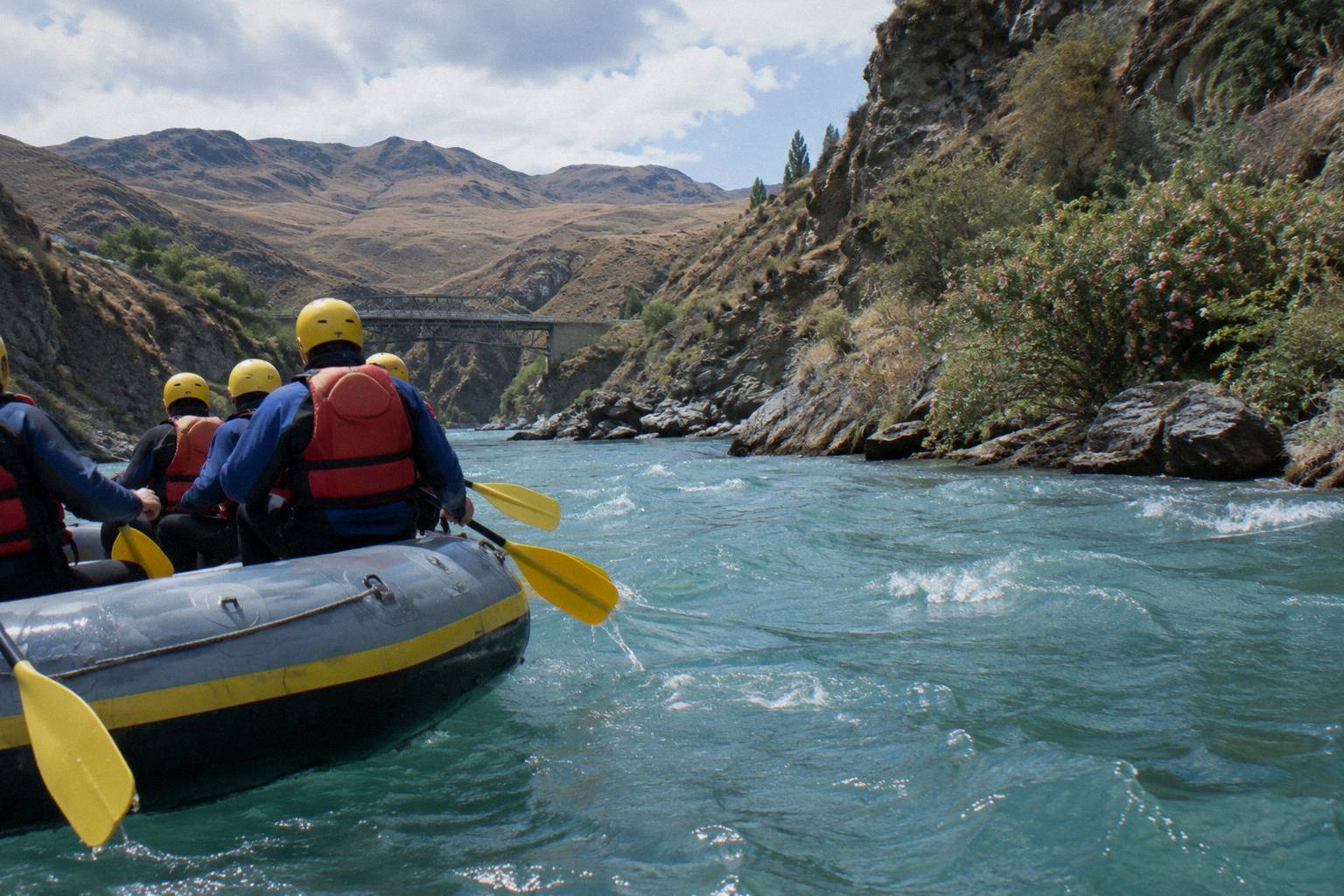
The comparison is worth making carefully, because "safer" is not the same as "safe". The Kawarau's own description says it is usually graded 2 to 3 but can reach grade 4 at higher water levels, and its headline rapid, The Dog Leg, is 400 m long, which the operator calls the longest commercially rafted rapid in New Zealand, graded 3/4 on the operator page. That is a genuine white water experience. The difference is in the margins: the Kawarau suits first-timers and less confident swimmers, water confidence is still recommended, and the RealNZ statement about a higher risk of falling out applies to the Shotover, not the Kawarau. The wider set of guides lives on Queenstown White Water Rafting.
| Measure | Shotover River | Kawarau River |
|---|---|---|
| Usual grade | 3 to 5 | 2 to 3, can reach grade 4 at higher water |
| Scale of the run | 14 km, six grade 3 to 5 rapids, the 170 m Oxenbridge Tunnel | 8 km, ending in the Gibbston Valley; The Dog Leg rapid is 400 m |
| Who it suits | Water-competent guests, able to swim 25 m unaided, moderate fitness | First-timers and less confident swimmers, water confidence recommended |
| Falling out | Operator states a higher risk of falling out than the Kawarau | The gentler profile of the two rivers |
| On-water support | Rafts of at most eight including the guide; a safety kayaker on each trip | Full gear and briefing; optional cliff jumping only if weather and water level allow |
| Family access | Minimum age 13 | Minimum age 13; the grade 1 and 2 family trip runs in Skippers Canyon on the Shotover |
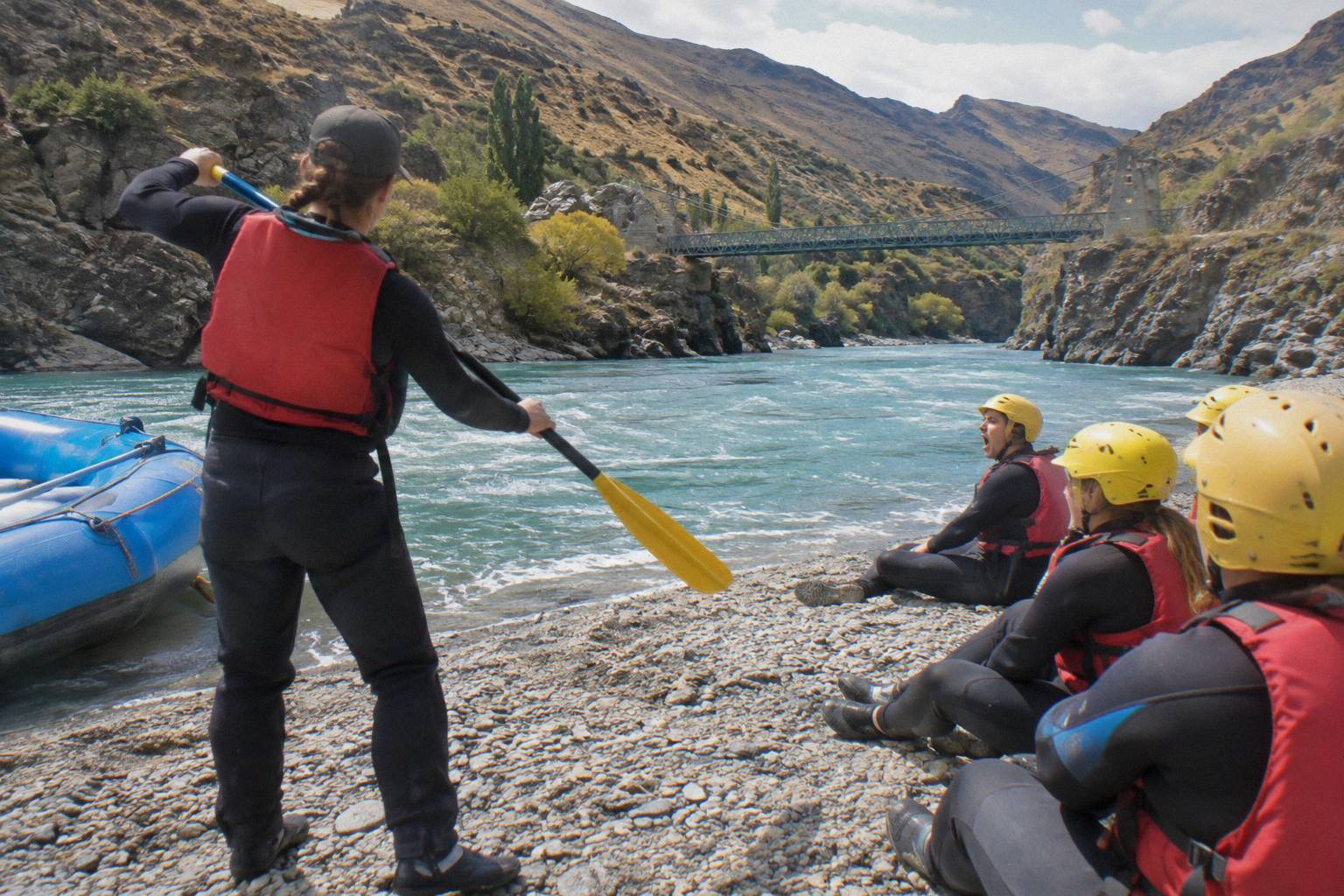
The Shotover's safety story has a specific shape. Rafts carry at most eight people including the guide, and a safety kayaker travels on each trip, paddling alongside the raft through the rapids rather than watching from the bank. Spectators are not allowed on the river; viewers can stand near the last rapid as rafts exit the tunnel, though timing varies. Trips depend on weather, river level and water temperature, portages may be required, and minimum guest numbers apply. For the full rundown of the river itself, see the Shotover river facts and flow guide, and the broader Shotover versus Kawarau comparison covers how the two days differ beyond safety, from the 40-minute shuttle up Skippers Canyon Road to Deep Creek to the Kawarau's drive out through the Gibbston Valley wineries.
The Kawarau base fare, from NZ$249 per person, is the natural first rafting trip, and the itinerary shows how much of the day is built around preparation: meet at 88 Beach Street, bus 20 minutes to the base, a 30-minute safety briefing, another 20-minute bus to the river, then an hour of rafting.
What Happens In The Safety Briefing?
The briefing is where the trip's safety plan is transferred to you, and it is treated as mandatory rather than ceremonial: on the Kawarau itinerary it runs about 30 minutes at the base before the river, every guest must be able to understand it in English, and every guest signs a waiver before paddling. Paddle technique, positioning in the raft and the guide's commands are all covered before anyone is on moving water.
The detail worth noticing is the sequence. Gear is issued and fitted first, the briefing happens at the base, and only then does the bus continue to the river. By the time the raft touches water, everyone on board has heard the same instructions, in the same words, from the guide who will be calling them. That is why understanding the briefing in English is an eligibility requirement rather than a courtesy: a command that is heard but not understood is not a command. Guests who do not swim 25 m unaided, who cannot meet the fitness ask, or who arrive with a heart condition are screened before this point, so the briefing room is, by design, a room of people who can act on what is said.
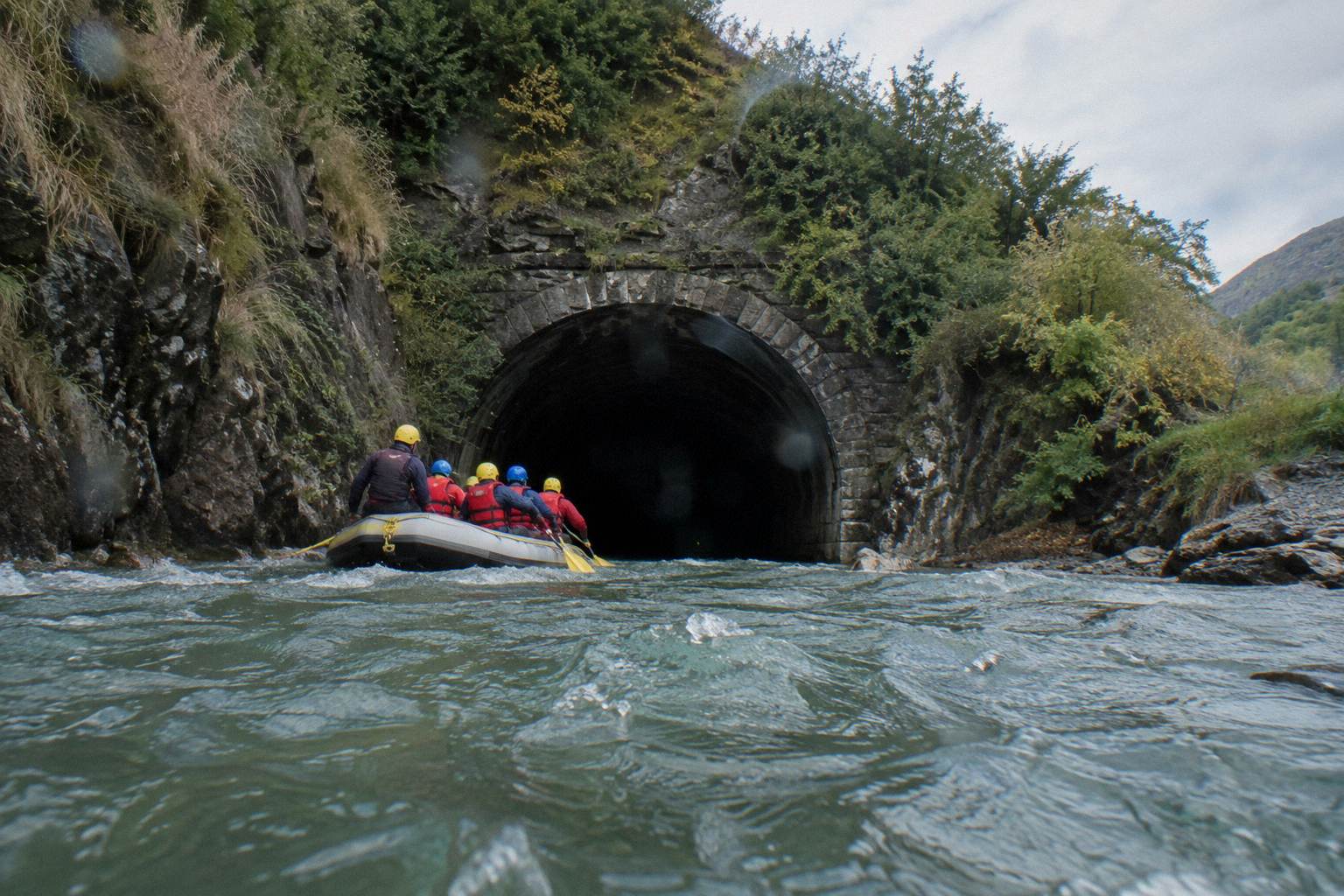
The briefing also sets expectations honestly, which is itself a safety function. You will hear that falling out is possible, and on the Shotover more likely than on the Kawarau, in the operator's own comparison. You will hear the plan for the day, including any portage if conditions require one. The Challenge Rafting Shotover trip adds a small but telling inclusion: professional photos are part of the booking, so nobody is tempted to smuggle a camera on board to capture the tunnel. For nervous first-timers, the rafting fear and nerves guide and the white water rafting for beginners primer cover what a first trip actually feels like, rapid by rapid.
Does Weather Ever Stop A Rafting Trip?
Yes, and the decision sits with the operator, not the customer: trips run depending on weather, river level and water temperature, portages may be required when a section should not be rafted, and minimum guest numbers apply. The optional cliff jumping on the Kawarau is likewise weather and water level dependent, and Challenge Rafting simply does not run its Shotover trips in winter, operating November through April.
This is the layer most first-timers underestimate, in both directions. Some expect a show-that-goes-on mentality and are surprised a trip can be pulled; others assume a storm cancels everything and are surprised the river often runs. The reality is a daily judgment call against three separate conditions, plus a seasonal one on the Challenge Rafting side, where winter runs May to early September and no rafting is offered then. The best time for rafting in Queenstown and winter rafting in Queenstown guides dig into the seasonal picture, including which trips publish operating months and which do not.
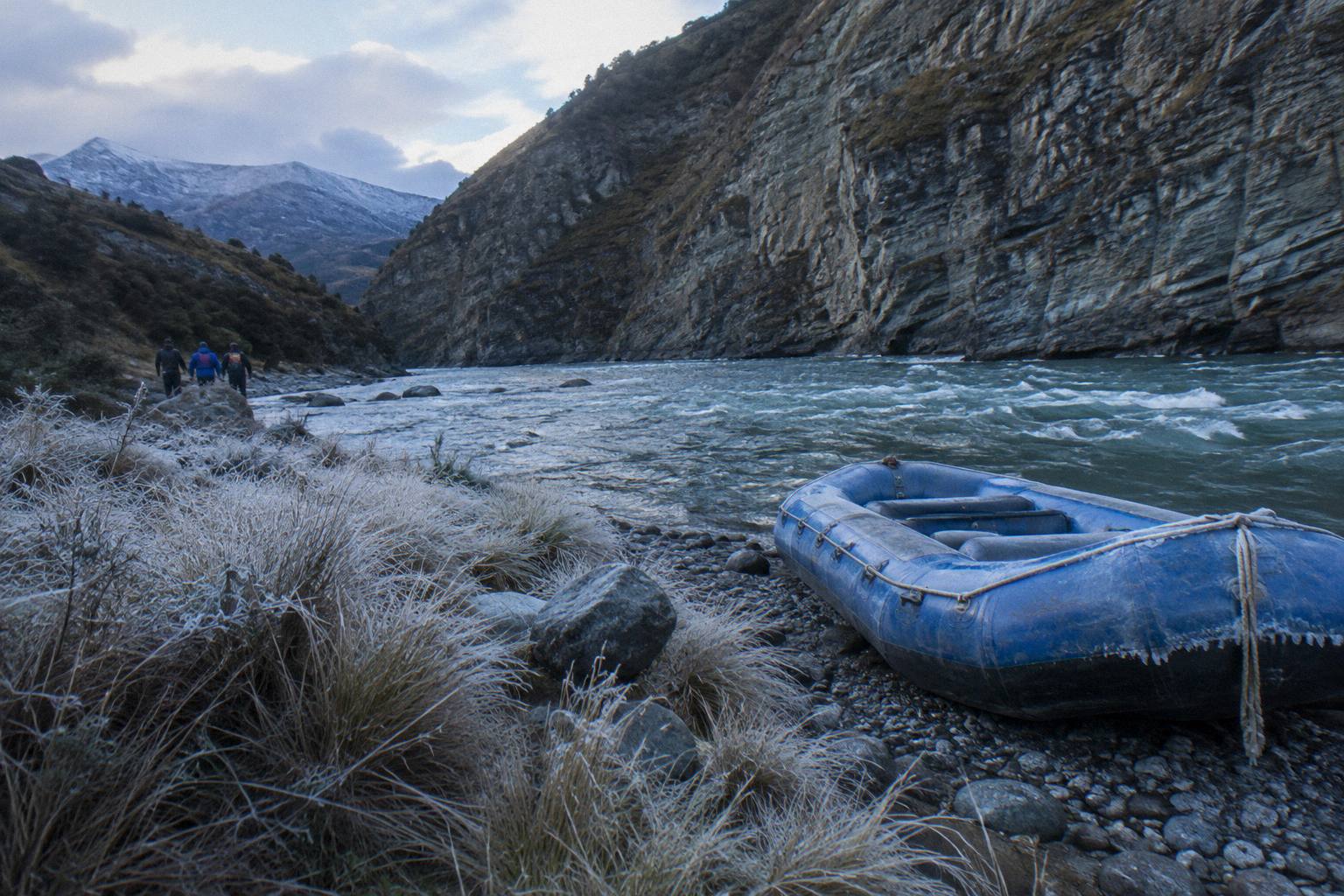
A cancelled or modified trip is the system working, not failing. A portage, where the crew walks a section around rather than through it, is the river version of a captain rerouting a ferry. What you should not do is treat a forecast as a reason to skip the booking conversation: conditions are assessed close to the day, and the people assessing them are the ones holding the safety audit. The general rule for planning is to book the trip you want and let the operator make the call, which is also why free cancellation matters where it exists; every trip carries free cancellation up to 24 hours before start.
What Safety Mistakes Do First-Timers Make?
The avoidable mistakes are consistent: wearing cotton or street clothes under the wetsuit instead of swimwear, bringing glasses without a sports strap, trying to take a camera or GoPro on the raft where they are banned, underestimating the swimming requirement on the Shotover, and booking a river above their water confidence because it looked exciting. None of these are dramatic errors; they are small frictions that erode the safety layers the trip is built on.
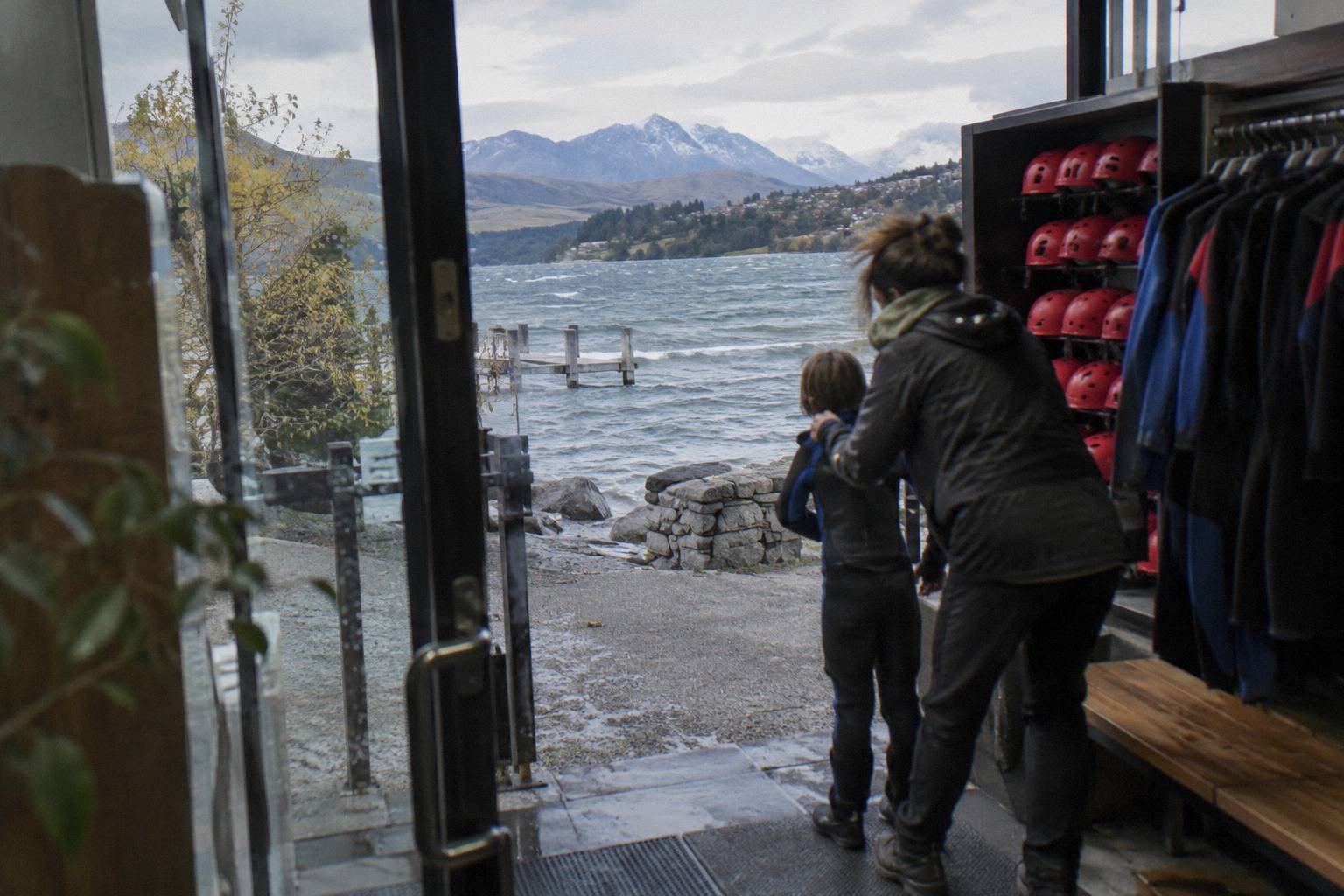
Most of the list costs nothing to fix. Swimwear only under the wetsuit, no cotton, is a two-minute wardrobe decision the night before. Glasses with a sports strap, or left behind, is the same. Cameras are a rule to accept rather than argue with on the RealNZ Shotover trip, where nothing can be taken on the raft, and where the operator's photos or the included package on the Challenge trip cover the memory anyway. The bigger mistakes are booking errors: choosing the Shotover when you cannot comfortably swim 25 m unaided, or ignoring the moderate fitness ask, or assuming a child under 13 can join a graded-river trip when the family option in Skippers Canyon, from age 3, is the one built for them. If nerves are the real obstacle, that is a different problem with different answers, and rafting with kids in Queenstown covers the family side properly.
What Is The Story Behind The Oxenbridge Tunnel?
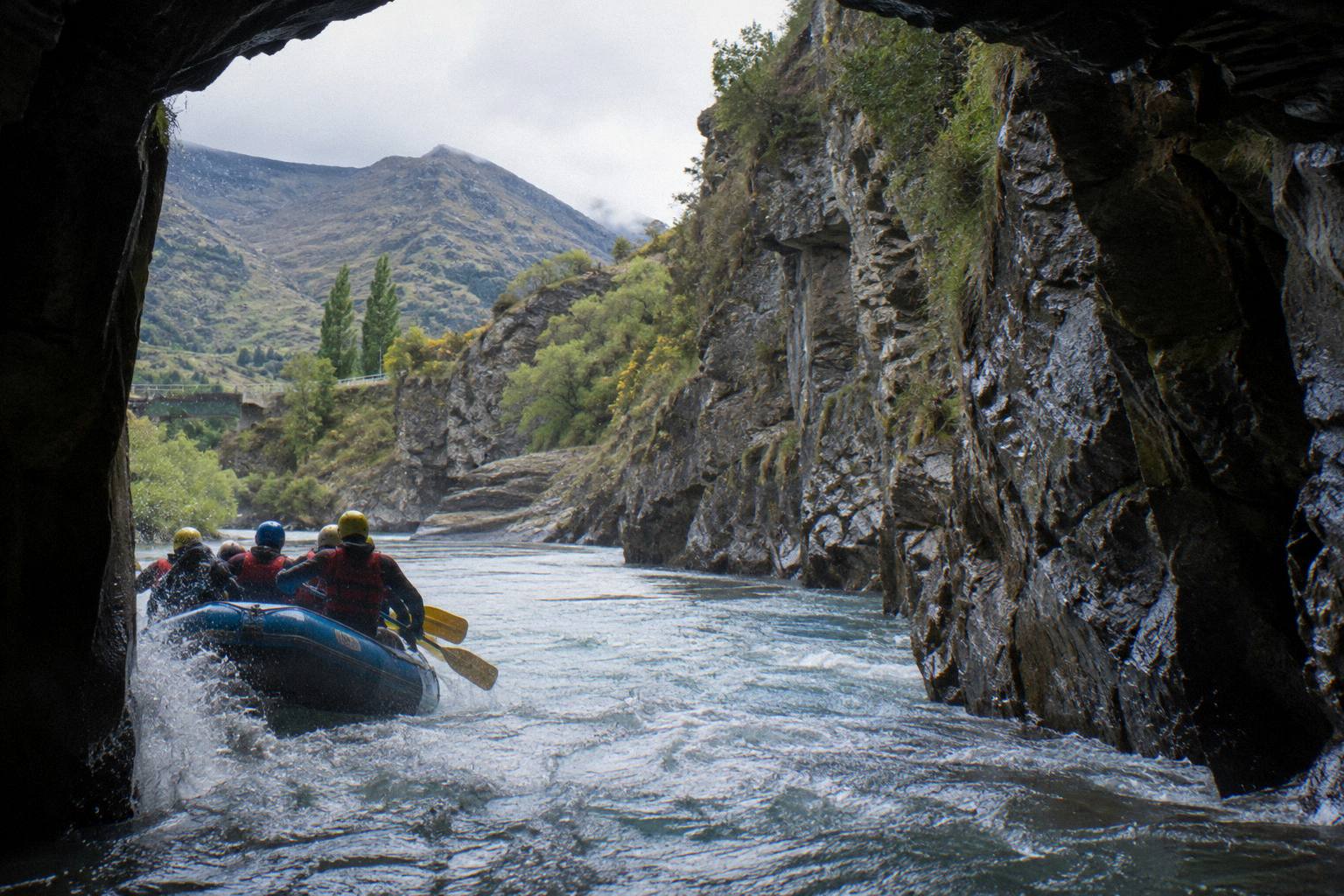
The 170 m Oxenbridge Tunnel that Shotover rafts pass through was built from 1906 by the Oxenbridge Brothers to divert the Shotover away from the gold-rich Jeweller's Shop rapids above Arthurs Point; the mining company behind it was liquidated in 1912, and today the tunnel still carries the river flow and is used primarily by rafting companies. Heritage New Zealand also records that a 1995 death led to one of the tunnel's original outlet channels being filled in.
The tunnel is the clearest example of how safety on a river is layered over time. An engineering failure by mining standards, incorporated in October 1909, first return in 1911, liquidated by August 1912, became a permanent feature of the river that commercial rafting now routes through, and the 1995 change to the outlet channels shows the river's features being modified in direct response to a tragedy. The details are recorded in Heritage New Zealand's list entry for the tunnel. The Department of Conservation also maintains a short, easy 20-minute walk, the Oxenbridge Tunnel Track, to a viewpoint over the tunnel diversion and an old steam engine, reached by turning left just before the Edith Cavell Bridge at Arthurs Point, and the wider Skippers area is part of the 9,100 ha Mount Aurum Recreation Reserve administered by DOC, which saw much of Wakatipu's 1860s gold fever.
Whether all of that adds up to a trip for you depends on one honest self-assessment: your swimming, your fitness and your appetite for grade 3 to 5 water. If the answer lands on the gentler side, the family trip through Skippers Canyon runs grade 1 and 2 rapids with gold mining relics from age 3 upwards, and the Skippers Canyon guide explains the historic road in. If it lands on the far side, Queenstown White Water Rafting exists for exactly that, and check availability on the Shotover half day before reading further in the full Shotover rafting rundown.
These three trips cover the full safety spectrum, from a grade 1 and 2 canyon float suitable from age 3, through the first-timer-friendly Kawarau, to grade 3 to 5 Shotover white water.
Common Questions About Rafting Safety
Is White Water Rafting Safe For Beginners?
Yes, on the right river. The Kawarau is graded 2 to 3 and the operator says it suits first-timers and less confident swimmers, with water confidence still recommended. Every trip includes a roughly 30-minute safety briefing, full wetsuit, helmet and life jacket, and operators must be registered with WorkSafe and have passed a safety audit.
Do You Need To Be Able To Swim To Go Rafting?
On the graded rivers, yes. RealNZ asks that guests be water-competent and able to swim 25 m unaided, and non-swimmers are not suitable for the Challenge Rafting Shotover trip. The exception is the Skippers Canyon family trip, which is suitable from age 3 upwards with water confidence not necessary on grade 1 and 2 rapids.
Can You Fall Out Of The Raft?
Yes, it is possible on any graded river, and the operator states plainly that the Shotover carries a higher risk of falling out than the Kawarau. That is why life jackets are mandatory, a safety kayaker travels on each RealNZ Shotover trip, and every guest attends the safety briefing before launch.
What Health Conditions Stop You From Rafting?
Any heart condition except blood pressure managed with medication excludes, as does pregnancy on the graded rivers. Weight must fall between 40 kg and 120 kg and is verified at check-in. There is no maximum age; a good level of physical fitness is asked and disabilities are assessed case by case.
Can Rafting Trips Be Cancelled For Safety?
Yes. Trips run depending on weather, river level and water temperature, portages may be required, and minimum guest numbers apply. Challenge Rafting operates its Shotover trips November through April only and runs no rafting in winter, which it defines as May to early September.
Can Kids Go White Water Rafting In Queenstown?
On the graded Shotover and Kawarau trips the minimum age is 13, with under 16s needing a guardian and under 18s needing guardian consent and a signed waiver. The Skippers Canyon family trip is the exception, suitable for everyone from 3 years upwards on grade 1 and 2 rapids.