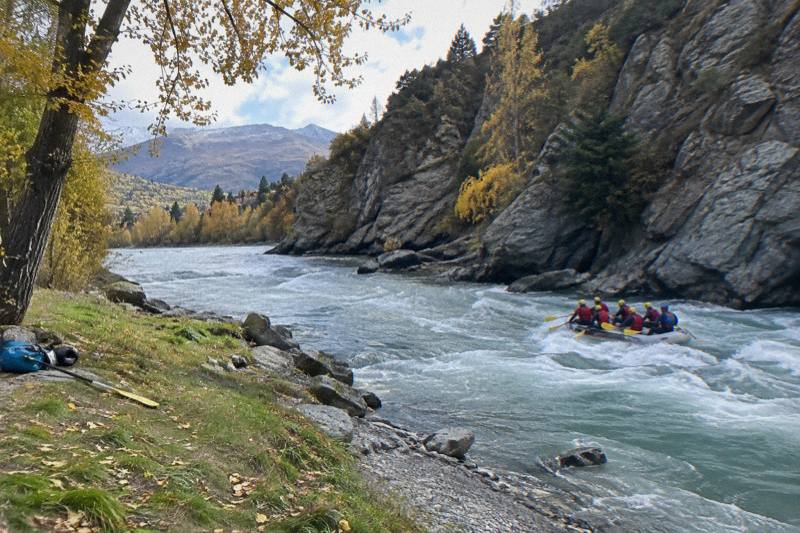
Glasses, Cameras And Valuables On A Rafting Trip
Nothing goes on the RealNZ raft, not a camera, not a GoPro, not a phone in a pocket. Here is what stays behind, what goes in the locker, and where the photos of your run come from.
Short answer
On the Shotover and Kawarau rafting trips, cameras, GoPros and phones cannot be taken on the raft. Glasses need a sports strap or stay behind. A valuables locker and hot showers wait at the Arthurs Point raft base, and the Challenge Rafting Shotover trip includes professional photos in the booking.
Can You Take A Camera On The Raft?
No camera, GoPro, phone or any personal device goes on the raft on the RealNZ Shotover or Kawarau trips. The operator's rule is flat: nothing can be taken on the raft. The reasoning is simple, the Shotover runs grade 3 to 5 whitewater with a real chance of swimming, and a loose object in a flipping raft becomes a hazard for everyone aboard, not just its owner.
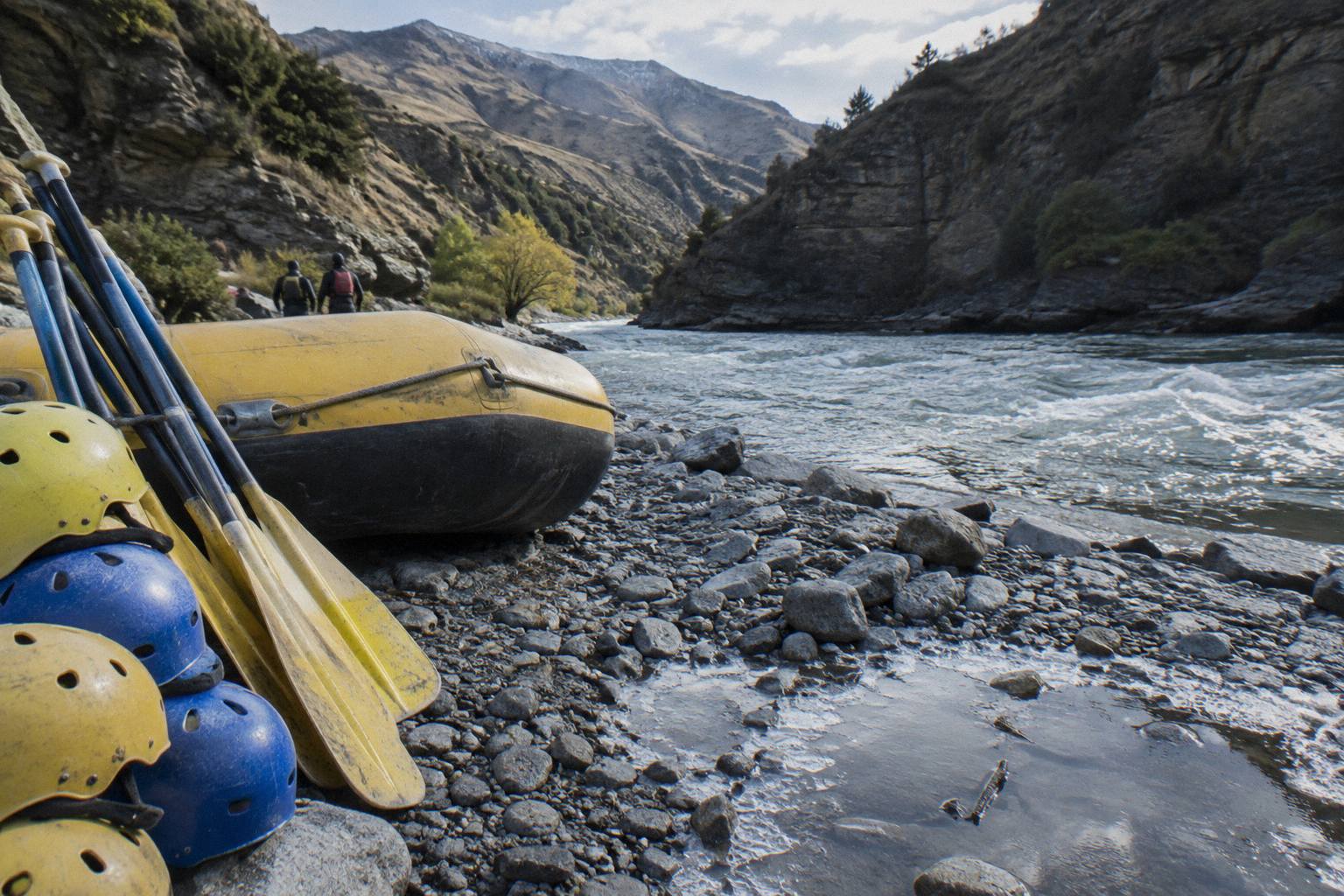
That rule surprises people who have rafted elsewhere with a helmet mount or a chest strap. On Queenstown's commercial rivers the equipment list is closed: wetsuit, wetsuit jacket, spray jacket, paddle, helmet, wetsuit booties and life jacket, all provided. There is no mounting point, no exception made for waterproof housings. Even the housing that survived a week of ocean snorkelling is not invited, because the rule is not about waterproofing. It is about attachment, entanglement and the speed at which a grade 5 rapid separates a person from their pockets.
It is worth understanding why the rule is so firm. Rafts on the Shotover carry at most eight people including the guide, with a safety kayaker travelling on each trip. The run passes six grade 3 to 5 rapids and through the 170 m Oxenbridge Tunnel. In that environment a phone in a pocket is a loss waiting to happen, and a camera strap is something that can catch. The gear you bring that is not rafting gear is gear the crew has to think about, and a guide thinking about your GoPro is a guide not watching the water.
The practical answer is to plan around the rule rather than fight it. Photos of your run exist, and on at least one Queenstown trip they are included in what you pay for. Leave the device in the locker, ride the river with both hands on the paddle, and collect the evidence afterwards. The sections below cover exactly where each item belongs and which trip hands you professional photos at the end of the day.
A note on expectations before the practicalities. The no-device rule is uniform across the two Shotover operators and the RealNZ Kawarau trips, so you cannot shop your way around it by picking a different grade 3 to 5 run. What varies between trips is what happens to the photos question afterwards, and that is where a small amount of research pays off before you ever reach the river bank.
Where Do Cameras And Phones Actually Stay?
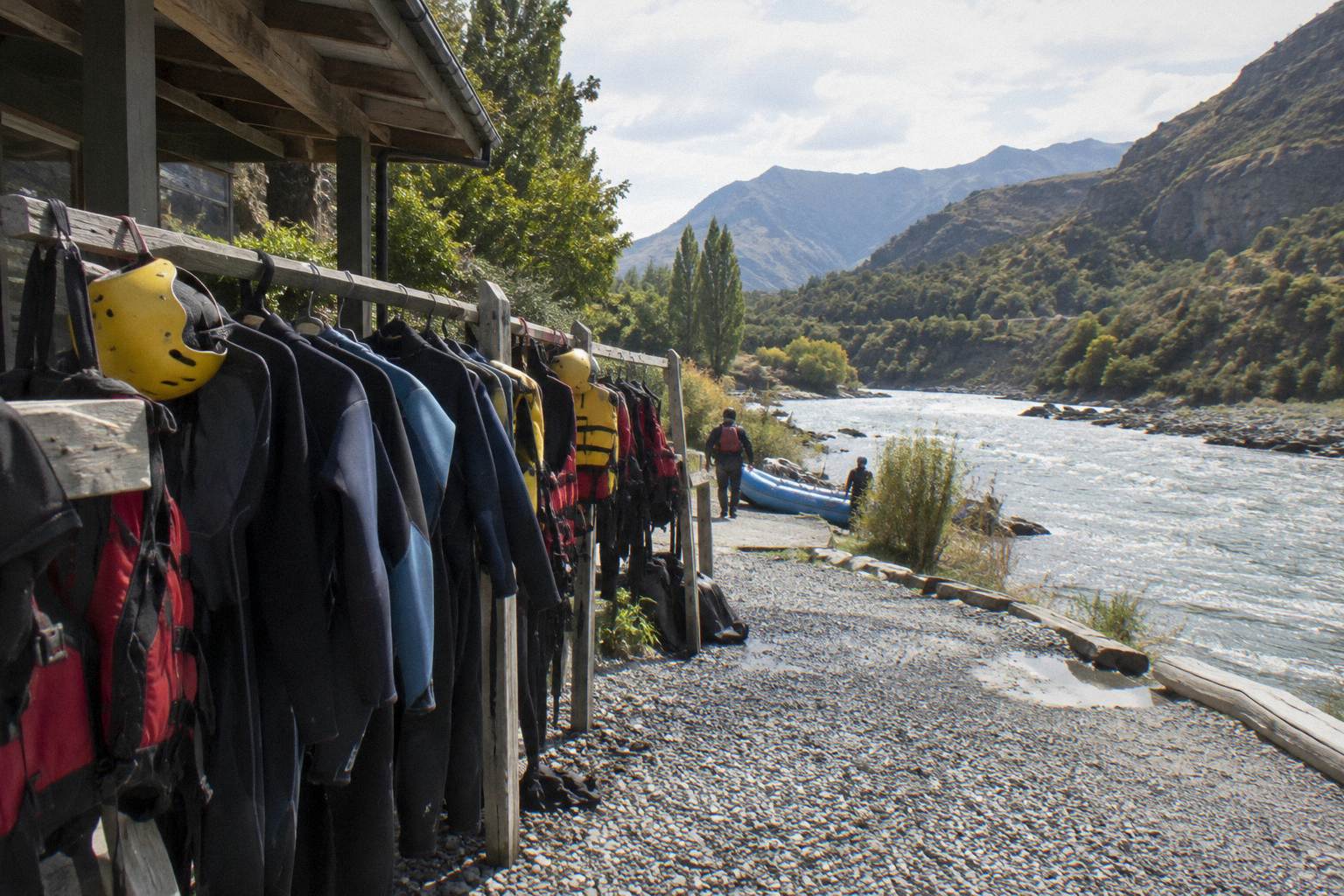
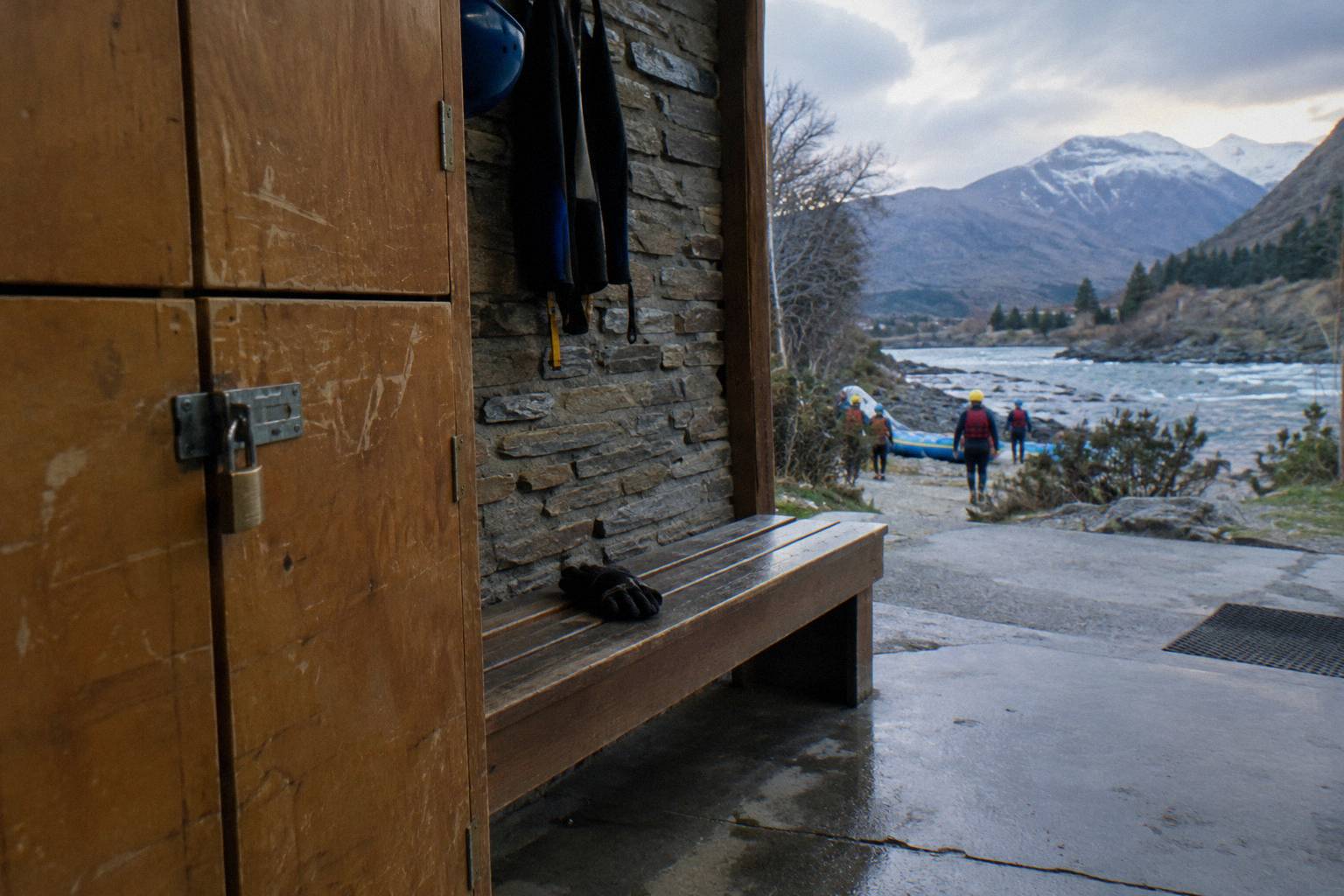
Cameras, phones and anything else you cannot take on the raft stay out of the trip entirely or in the valuables locker at the raft base. The RealNZ raft base sits on the Shotover bank at Arthurs Point, roughly a 10 minute drive from Queenstown, and it has both hot showers and a valuables locker for guest use. Nothing of value should ride the shuttle bus in an open bag.
The cleanest split is three places: your accommodation, the locker, and nowhere else. A camera you want for the scenery, not the rapids, can stay at the hotel and come out for Lake Wakatipu at dusk. A phone you need for the day goes in the locker at the base and comes back out for the hot shower and the ride home. The one place it never goes is the raft.
The bus legs deserve a mention, because this is where most losses actually happen rather than in the rapids. On the RealNZ Shotover trip the shuttle reaches the put-in at Deep Creek via Skippers Canyon Road, about a 40 minutes' drive to the start. On the Kawarau trips the bus legs are shorter but there are several of them, including a 30 minute break mid-itinerary. Loose items migrate on buses.
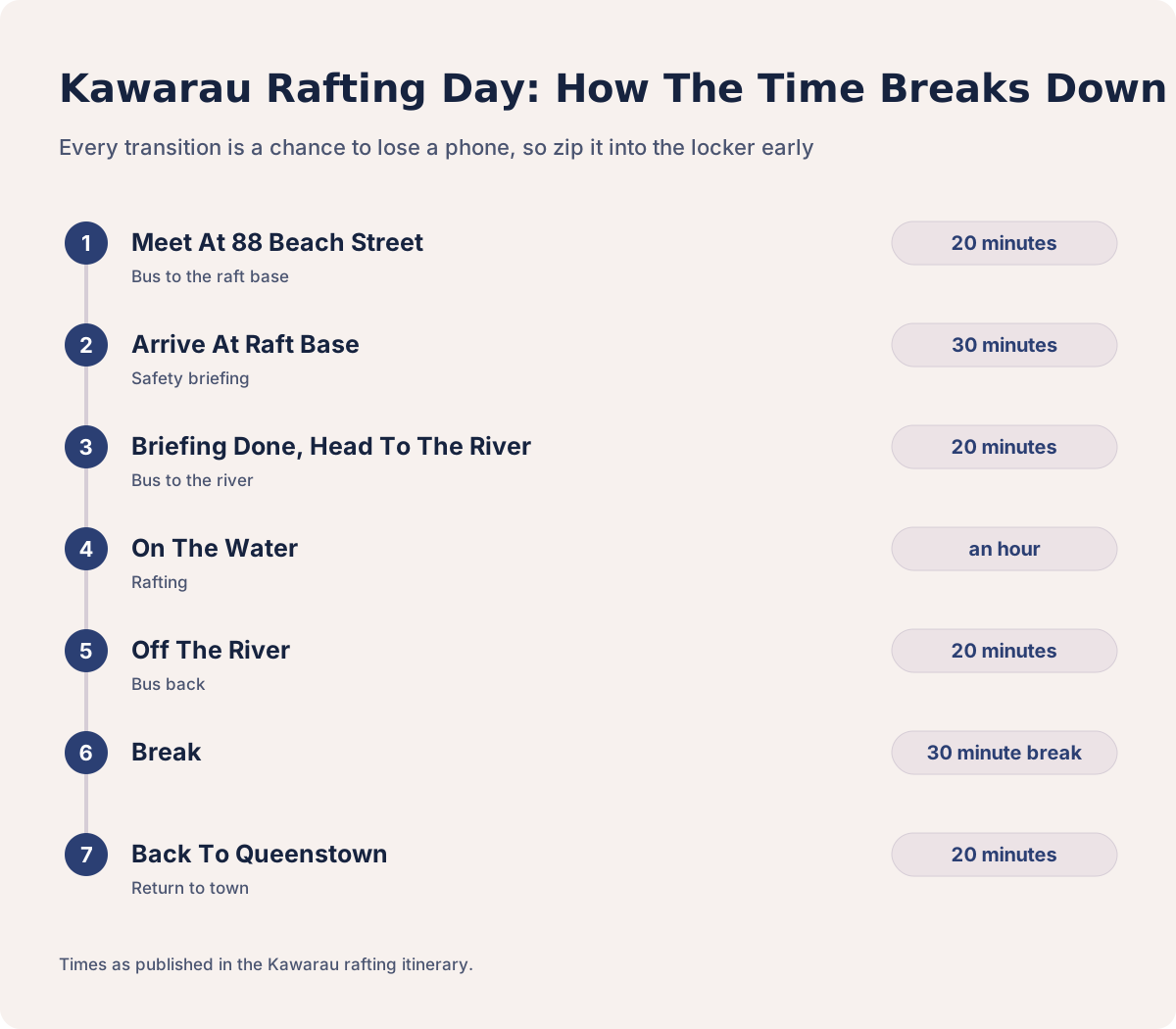
The Kawarau itinerary shows just how much ground a small bag covers in a day: meet at 88 Beach Street, bus 20 minutes to the base, a 30 minute safety briefing, another 20 minutes to the river, an hour of rafting, 20 minutes back, a 30 minute break, then 20 minutes to town again. Every one of those transitions is a chance for a phone to slide under a seat. Zipping it into the locker at the first stop removes the whole category of risk from your afternoon.
If you want a fuller packing rundown for the day, the what to bring rafting checklist covers towels, swimwear and the small things, and the wetsuit and gear provided guide lists exactly what is handed out on each river.
| Item | On the raft | At the raft base | Best left at accommodation |
|---|---|---|---|
| Phone | No | Yes, in the valuables locker | Yes |
| Camera or GoPro | No | Yes, in the locker | Yes |
| Glasses | Only with a sports strap | Yes | Yes, if you can manage without |
| Towel and change of clothes | No | Yes, for after the showers | Either |
| Passports, wallets, keys | No | Yes, in the locker | Yes |
The band above is the shortlist for the day: the two Shotover trips, the Challenge Rafting descent with photos included and the RealNZ Shotover half day. Whichever you pick, check the meeting point on the booking page before the day.
Do You Get Photos On A Queenstown Rafting Trip?
Yes, and on one trip they are included rather than sold. The Challenge Rafting Shotover trip includes professional photos in the booking, which means a photographer-side arrangement captures the run and you do not carry anything onto the water. The RealNZ trips have no camera on the raft either, so photos there are a question to ask when booking rather than something to plan around packing.
This distinction matters more than people expect. A rafting trip without any images is a strange thing in a travel year, and the difference between included photos and no photos is the difference between relaxing on the bus home and kicking yourself. It is one of the quiet reasons the Challenge Rafting trip, 4 hours, from NZ$299 per person, 4.9 from 80 reviews, keeps its following: the photo question is already answered.
The included-photos detail sits inside a trip that otherwise looks a lot like its river sibling. It runs grade 3 to 5 water, the Mother rapids series of six grade 4 to 5 rapids with names like Aftershock, Squeeze, Toilet and Pinball, then the Oxenbridge Tunnel and the drop into Cascade Rapid. Check-in is at 88 Beach Street, with no pickup from accommodation, and guests may self-drive to the raft base at 1 Arthurs Point Road, Arthurs Point.
On the RealNZ side, the plain framing is that nothing goes on the raft and no photo inclusion is published. Ask when booking whether images are offered for the date you choose, and if the answer matters to you, weigh the Challenge Rafting trip, whose photos are part of the booking, against the RealNZ Shotover half day, from NZ$299 per person, 4.8 from 346 reviews, a 4.5 hour experience covering 14 km of river.
| Trip | Photos | Camera on raft | Notes |
|---|---|---|---|
| Challenge Rafting, 4 Hours | Professional photos included in the booking | No | Shotover, grade 3 to 5 |
| Shotover Rafting, Half Day | Ask when booking | No, nothing goes on the raft | 14 km, 4.5 hours total |
| Kawarau Rafting Only, Base Fare | Ask when booking | No, nothing goes on the raft | Grade 2 to 3, from NZ$249 |
| Rafting Plus Jet Boat Combo | Ask when booking | No, nothing goes on the raft | Adds a 25-minute jet boat transfer |
One trick worth knowing: the Family Adventures Skippers Canyon trip, grade 1 and 2 water suitable from 3 years upwards, sits in a different world of risk, so check with the operator about cameras on that one rather than assuming the big-river rule transfers. The gentler the water, the more worth asking the question becomes.
Ratings deserve a careful read too, since pool sizes vary a lot. A 4.9 from 80 reviews and a 4.8 from 346 reviews are both strong signals from real groups of guests, while a 5.0 from 7 reviews tells you fewer people have weighed in. Print the count in your head alongside the number, always, and the comparison between trips becomes much more useful than a bare star figure.
What About Glasses, Sunglasses And Contact Lenses?
Glasses need a sports strap or they stay behind, full stop. That is the operator's own wording for the RealNZ trips, and it applies to prescription glasses and sunglasses alike. Contact lenses are an option you can consider, though the operator's rule for eyewear is the strap, so bring your own rather than expecting one to be handed out.
The physics of the situation is unforgiving. A grade 4 rapid delivers enough force to strip unsecured glasses off a face in a second, and the Shotover specifically carries what the operator calls a higher risk of falling out than the Kawarau. A swim in the Oxenbridge Tunnel approach is exactly the moment you want to be able to see the guide's paddle signals.
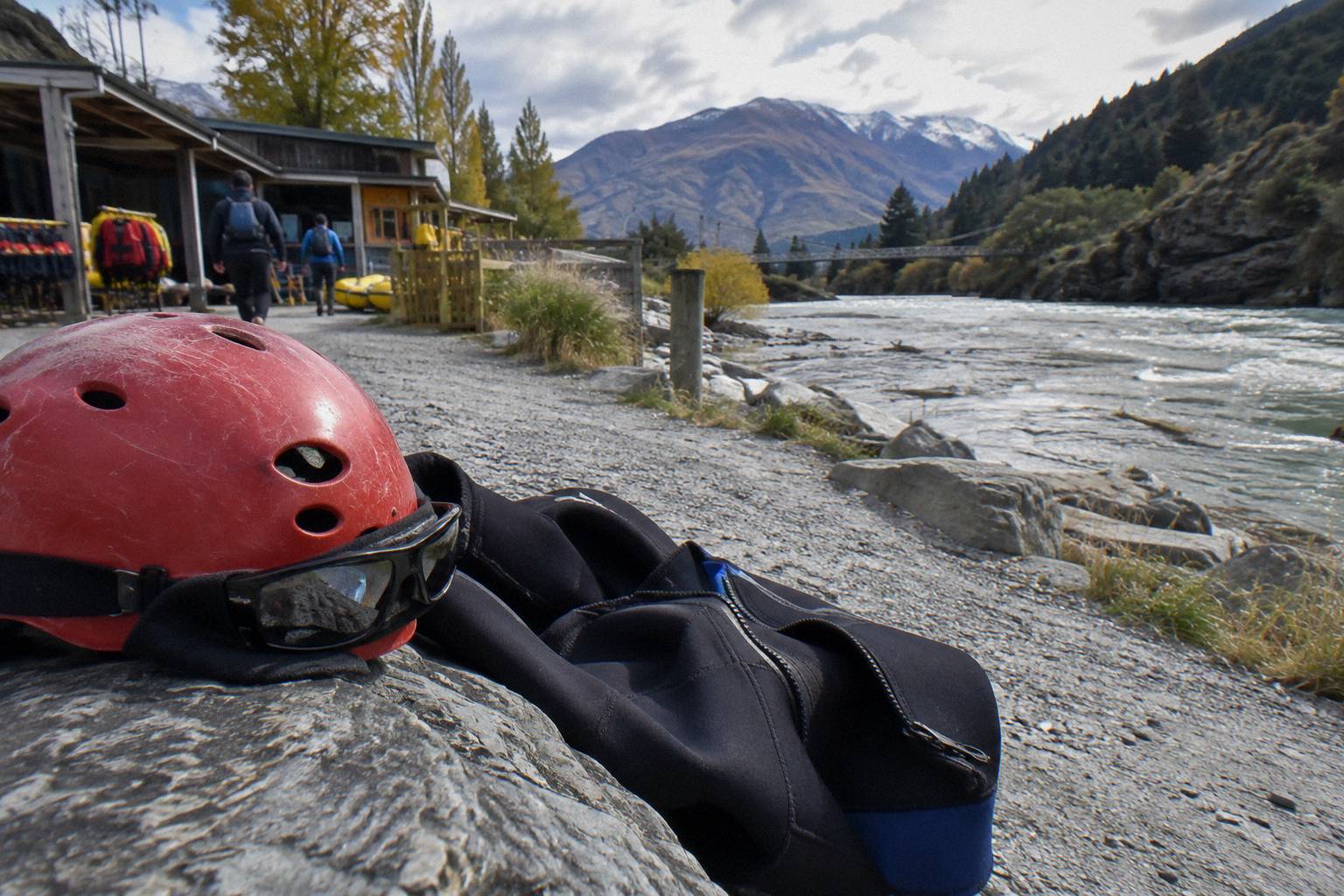
Prescription wearers should think in tiers. Tier one, daily contact lenses worn under the helmet, an option you can consider. Tier two, glasses with a proper sports strap or tie, accepted under the operator's rule. Tier three, raft without correction if your prescription is mild, since the guide does the seeing for you. What is not on the list is loose glasses on the river.
There is a small catch worth flagging for the family trip. The Family Adventures booking text says to wear a swimsuit under clothes and the trip is a gentle one, grade 1 and 2, so the same strap rule is the safe default there too. If your child wears glasses, the strap conversation happens before you leave the house, not at the river bank. The rafting with kids guide covers the rest of that packing puzzle.
Sunglasses follow the same logic as prescription pairs even though losing them stings less. A cheap pair with a strap will survive the day; an expensive pair without one probably will not, and UV glare off the water is real enough that some eye cover is worth having on the flatter stretches. Whichever you choose, the strap is the non-negotiable part, and a strap that clips on at the temple rather than sliding along the arm holds better under a helmet.
| Eyewear option | Works on the raft | What to do |
|---|---|---|
| Contact lenses | Yes | Bring spares and solution for after the showers |
| Glasses with a sports strap | Yes | Bring your own sports strap or tie |
| Loose glasses or sunglasses | No | Leave in the locker or at accommodation |
| Reading glasses only | Rarely needed | Leave behind; the guide runs the river |
What Should You Leave At Your Hotel Before Rafting?
Leave passports, flight details, large wallets, jewellery, spare keys and any camera you would mourn. Swimwear is the only thing worn under the wetsuit, no cotton, so the day's wardrobe is small by design. Everything else you carry to the meeting point is either riding the bus in a bag or sitting in the locker, and the smaller that pile is, the better the day goes.
The 20 minutes before departure, spent at the RealNZ Visitor Centre at 88 Beach Street, are for check-in and weight verification, not for repacking a suitcase. Guests are asked to arrive at least 20 minutes before departure, and minimum weight 40 kg, maximum 120 kg, is verified at check-in. A heavy day bag slows you and everyone behind you.
A useful frame: pack for the trip as if the river will take anything soft. Then act surprised when it does not, because everything went in the locker. The items that genuinely earn their place on your person are a swimsuit worn under clothes for the ride to the base, a towel and dry clothes for after the hot showers, and any medication the operator needs to know about from the eligibility rules, since heart conditions and pregnancy exclude from grade 3 and above water.
Jewellery deserves a line of its own. Rings stay on fingers well enough, but necklaces, dangling earrings and anything that could slide off a cold, wet hand belong in the hotel safe. The wetsuit fits snugly against the skin, which is the point of it, and anything worn underneath that is not swimwear tends to press, pinch or vanish. Less under the wetsuit is genuinely more comfortable for the full hour on the water.
For the wider question of how the whole day runs, from check-in to showers, the rafting trip timeline and pickup guide walks the Kawarau itinerary minute by minute, and the what to wear rafting rundown settles the clothing question in full.
Can Anyone Watch And Take Photos From The Bank?
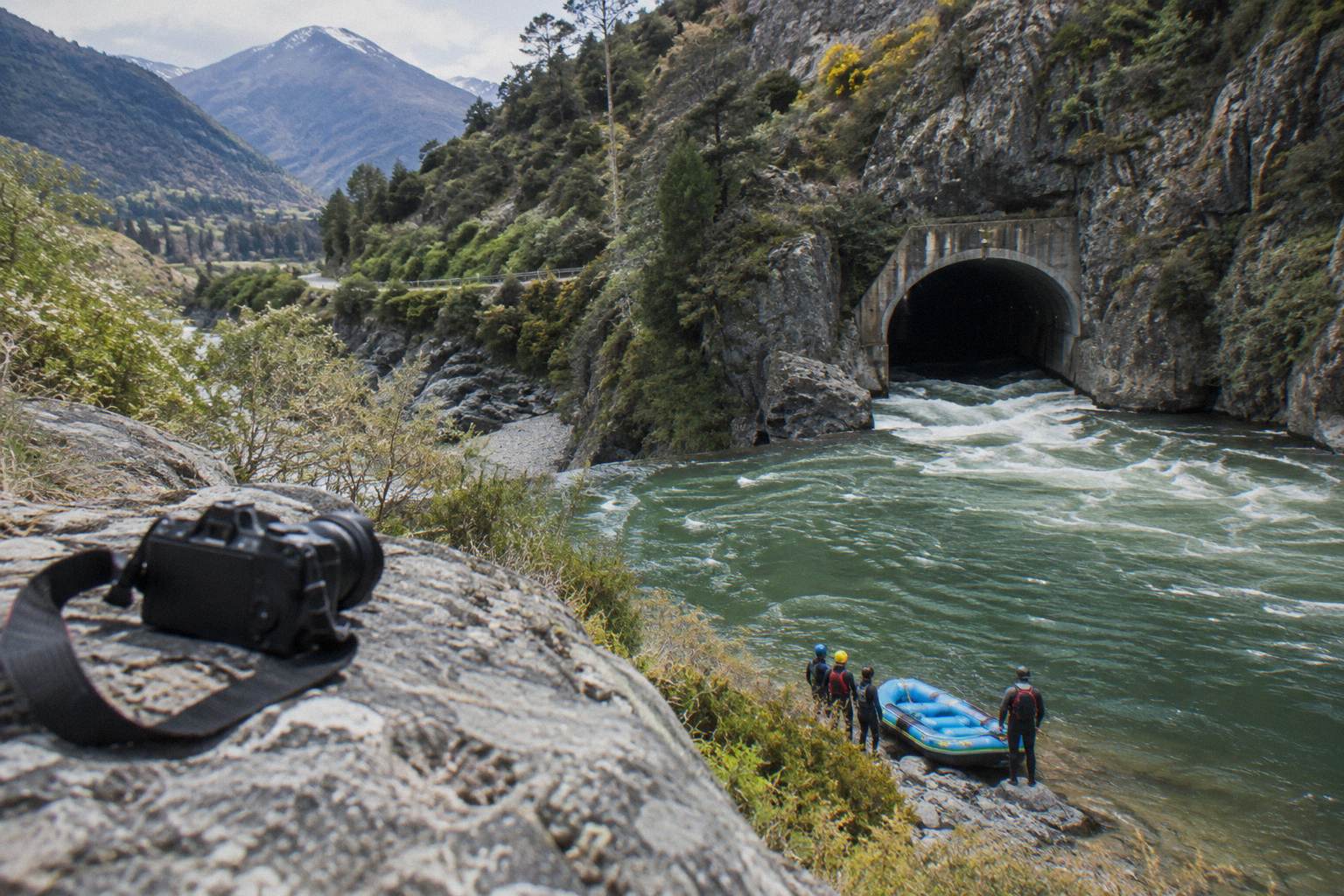
No spectators go on the river on any trip, but viewers can stand near the last rapid as rafts exit the Oxenbridge Tunnel, and that is the one spot where a partner or parent with a camera can genuinely capture the day. Timing varies with each departure, so a spectator needs the day's rough schedule from the booking calendar before committing to the drive out.
This is the workaround that makes the no-camera rule painless for couples and families splitting the day. The Arthurs Point raft base is about a 10 minute drive from Queenstown, and the Department of Conservation's Oxenbridge Tunnel Track is a short, easy 20 minute walk to a viewpoint over the historic tunnel diversion and an old steam engine, starting by turning left just before the Edith Cavell Bridge at Arthurs Point.
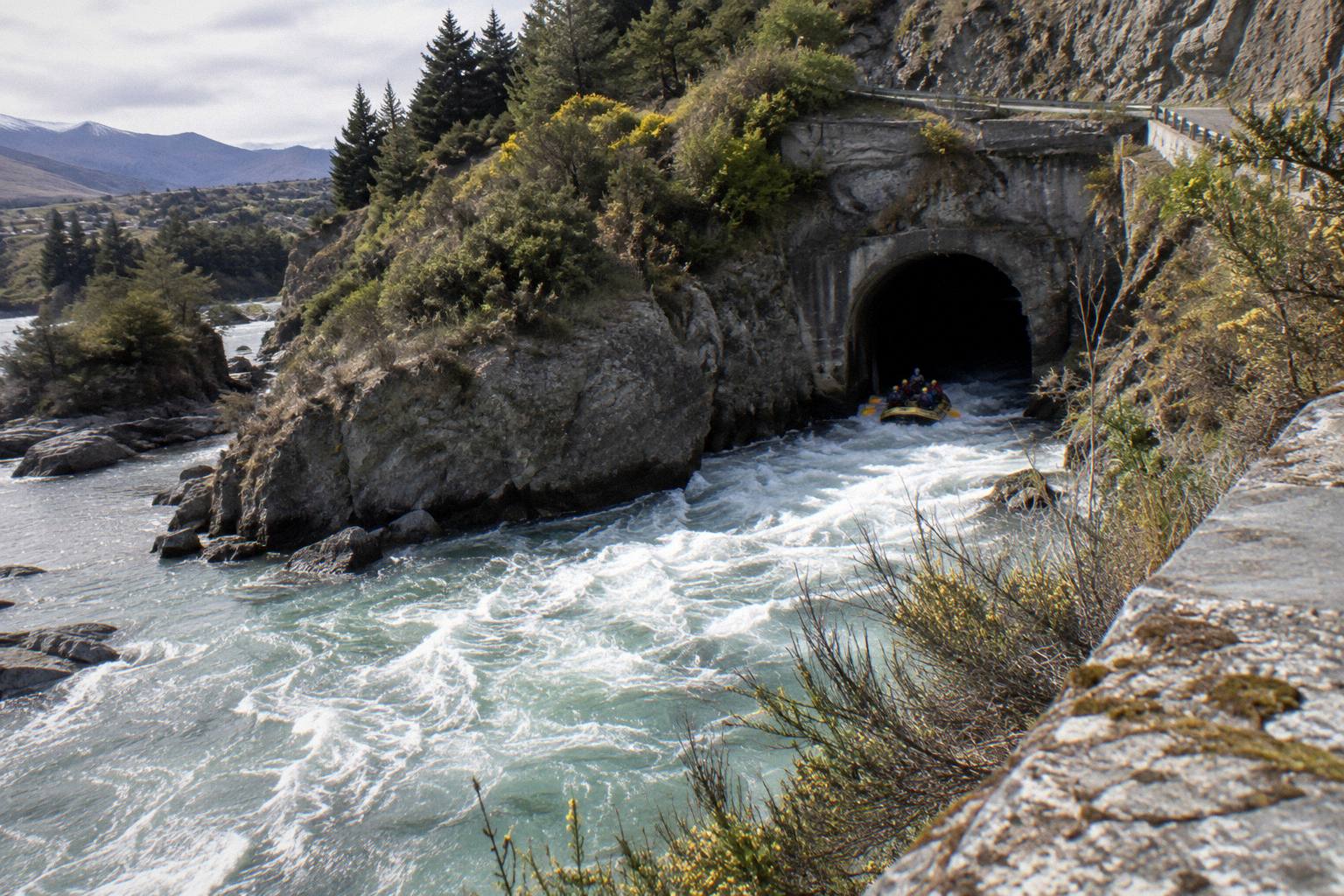
A spectator with a good lens and a bit of patience can get the shot of the trip: eight people in matching helmets bursting out of a 170 m tunnel into the last rapid. The tunnel itself has a story worth the walk, documented in Heritage New Zealand's list entry, and the wider canyon, part of the 9,100 ha Mount Aurum Recreation Reserve, is described by the Department of Conservation's Skippers area page.
For anyone driving out independently, note that Skippers Road is narrow, winding and unsealed, 13 km from Skippers Saddle to Skippers Bridge, and DOC advises that only experienced drivers should attempt it. The viewing spot near the tunnel exit at Arthurs Point is reached on sealed roads, so a nervous driver has a comfortable option.
Photography from the bank rewards a long lens and a fast shutter more than it rewards luck. Rafts move quickly through the final rapid, the light in the canyon is patchy, and there is usually only one pass per trip. A spectator who arrives early, finds the angle near the tunnel exit and pre-focuses on the water will do far better than someone pointing a phone hopefully at the gorge.
What Are The Common Packing Mistakes On Rafting Day?
The recurring mistakes are wearing cotton under the wetsuit, bringing loose glasses without a strap, carrying a phone in a pocket onto the bus and then having nowhere for it, and expecting to buy photos on the RealNZ trips when the only published photo inclusion is on the Challenge Rafting Shotover booking. Each one is avoidable with ten minutes of prep the night before.
Cotton is the sleeper issue. The rule is swimwear only under the wetsuit, no cotton, because cotton holds water against skin for the whole trip while the supplied wetsuit does the insulating work. A cotton t-shirt under a properly fitted wetsuit undermines the gear you are paying to wear. Pack the swimsuit, leave the shirt, and the gear does its job.
The phone-in-pocket habit costs people more cameras than the rapids do. The RealNZ Shotover half day runs 4.5 hours door to door, and for most of it your phone would be in a bag on a bus anyway. Plan the day so the phone lives in the locker from check-in at 88 Beach Street until after the hot showers, and the risk falls to roughly zero.
| Mistake | Why it costs you | Fix |
|---|---|---|
| Cotton under the wetsuit | Holds water against skin all trip | Swimwear only |
| Loose glasses on the water | One rapid can strip them off | Sports strap or contacts |
| Phone in a pocket | Nowhere secure once geared up | Locker at the raft base |
| Counting on buying photos later | Photo inclusion is published only on the Challenge trip | Ask when booking, or pick that trip |
The last mistake is subtler: assuming every rafting trip in town works the same way. The RealNZ Kawarau trips, grade 2 to 3 and suited to first-timers, and the Family Adventures Skippers trip, grade 1 to 2 from 3 years upwards, are different products from the grade 3 to 5 Shotover runs, and each has its own texture. The operator's own eligibility wording, water-competent and able to swim 25 m unaided on the Shotover, tells you these are serious rivers even when the sun is out.
One more mistake belongs to the morning itself: arriving at 88 Beach Street with wet hair, half-dressed and still eating breakfast. The check-in window exists so waivers can be signed, weights verified and under-18 guardian consent sorted before the bus loads. Arriving flustered means starting the safety briefing flustered, and the briefing is the part of the day you most want to hear clearly.
How Do You Choose A Trip When Photos Matter?
Pick the Challenge Rafting Shotover trip if included photos are the deciding factor, since professional photos come with the booking on that one, from NZ$299 per person. Pick the Kawarau raft and jet boat combo, from NZ$329, if you would rather trade rapid intensity for a 25-minute jet boat transfer with 360-degree spins covering 22 km of river before an hour of grade 2 to 3 rafting.
The RealNZ Kawarau trips suit first-timers and less confident swimmers, water confidence still recommended, and the combo adds a genuine second activity rather than a longer bus ride. The river is the Kawarau, the only outlet of Lake Wakatipu, flowing east from Queenstown, and rafting ends 8 km downstream in the Gibbston Valley, with the return leg passing the wineries and the Kawarau Bridge Bungy site.
There is also a middle path worth naming: the RealNZ Shotover half day and the Challenge Rafting trip both run the same river at the same from-price of NZ$299, so the photo inclusion can be the tiebreaker rather than a compromise. The RealNZ trip is 30 minutes longer overall at 4.5 hours and carries a much larger review pool; the Challenge trip pairs its included photos with the more concentrated four-hour format and hot showers at the Rafters Lodge afterwards.
Whichever trip you choose, the packing logic does not change: nothing on the raft, glasses strapped or left, valuables in the locker, dry clothes waiting for the showers. All commercial adventure activity operators in New Zealand must be registered with WorkSafe and have passed a safety audit, and the WorkSafe adventure activities register is searchable by name, activity and location if you ever want to check an operator's status yourself.
One last planning note: trips run depending on weather, river level and water temperature, portages may be required, and minimum guest numbers apply, so build a little flex into the day rather than a tight schedule afterwards. The Challenge Rafting season runs November through April with no winter rafting, while the RealNZ trips publish no operating months, so a shoulder-season booking is worth confirming when you check availability. Queenstown White Water Rafting trips reward the unhurried.
Common Questions About Rafting Day Essentials
Can You Take A GoPro On A Queenstown Rafting Trip?
No. Nothing, including cameras and GoPros, can be taken on the raft on the RealNZ Shotover and Kawarau trips. The Challenge Rafting Shotover trip instead includes professional photos in the booking.
Where Do You Leave Your Phone And Wallet?
A valuables locker is available at the raft base on the Shotover bank at Arthurs Point, about a 10 minute drive from Queenstown, alongside hot showers. Anything you will not need on the water is best left at your accommodation.
Can You Wear Glasses While White Water Rafting?
Glasses need a sports strap or stay behind, in the operator's own wording. Contact lenses are the common alternative. Bring your own strap, as one is not part of the supplied equipment.
Do The Rafting Trips Include Photos?
The Challenge Rafting Shotover trip includes professional photos in the booking. For the RealNZ trips no photo arrangement is published, so ask when booking if images matter to you.
Can A Friend Watch And Take Photos From The Side?
No spectators go on the river, but viewers can stand near the last rapid as rafts exit the Oxenbridge Tunnel. Timing varies with each departure, so check the day's schedule first.
What Do You Wear Under The Wetsuit?
Swimwear only, no cotton. The wetsuit, jacket, spray jacket, helmet, booties and life jacket are all provided on the RealNZ and Challenge Rafting trips.